
How to Search Santa Clara County Warrants
Warrant status in Santa Clara County is most often surfaced through the Superior Court Warrants and Corporate Summons page for traffic cases and the Case Information Portal for civil, criminal, probate, traffic, and small claims case data. The court's own guidance is clear about this. A traffic case lookup tells the user whether a warrant has issued and the date it issued. A criminal case lookup shows the warrant entry in the docket if one has been entered. No central public Santa Clara Sheriff active warrant list or "most wanted" warrant database was found in this research pass.
Start with the case type. If the case is a traffic citation, use the Traffic Case Info Portal linked from the court's traffic warrants page. If the case is criminal or civil, use the main Case Information Portal at portal.scscourt.org. The portal covers civil, small claims, probate, some family cases, traffic and local ordinance cases, and criminal cases. Filings are not generally online. Warrant status text and warrant issue dates do show up in case status fields.
If a name search returns nothing online, the next step is to call the clerk for the court that would have ordered the warrant. The criminal clerk at the Hall of Justice handles felony and most misdemeanor warrants. The traffic clerk at the Family Justice Center handles traffic warrants for the North County area. South County warrant questions go to Morgan Hill. Without a case number, the clerk may still help a caller verify warrant status by name and date of birth, but staff cannot guarantee a search outside the portal.
The court's Self-Help Topics landing page is a good starting point for users who do not know which courthouse holds the case. See the screenshot below.
The Superior Court's Self-Help portal lists every major case category, including links to traffic, criminal, and family resources that all tie into how warrants are issued. View the source at santaclara.courts.ca.gov/self-help/self-help-topics for the live page.
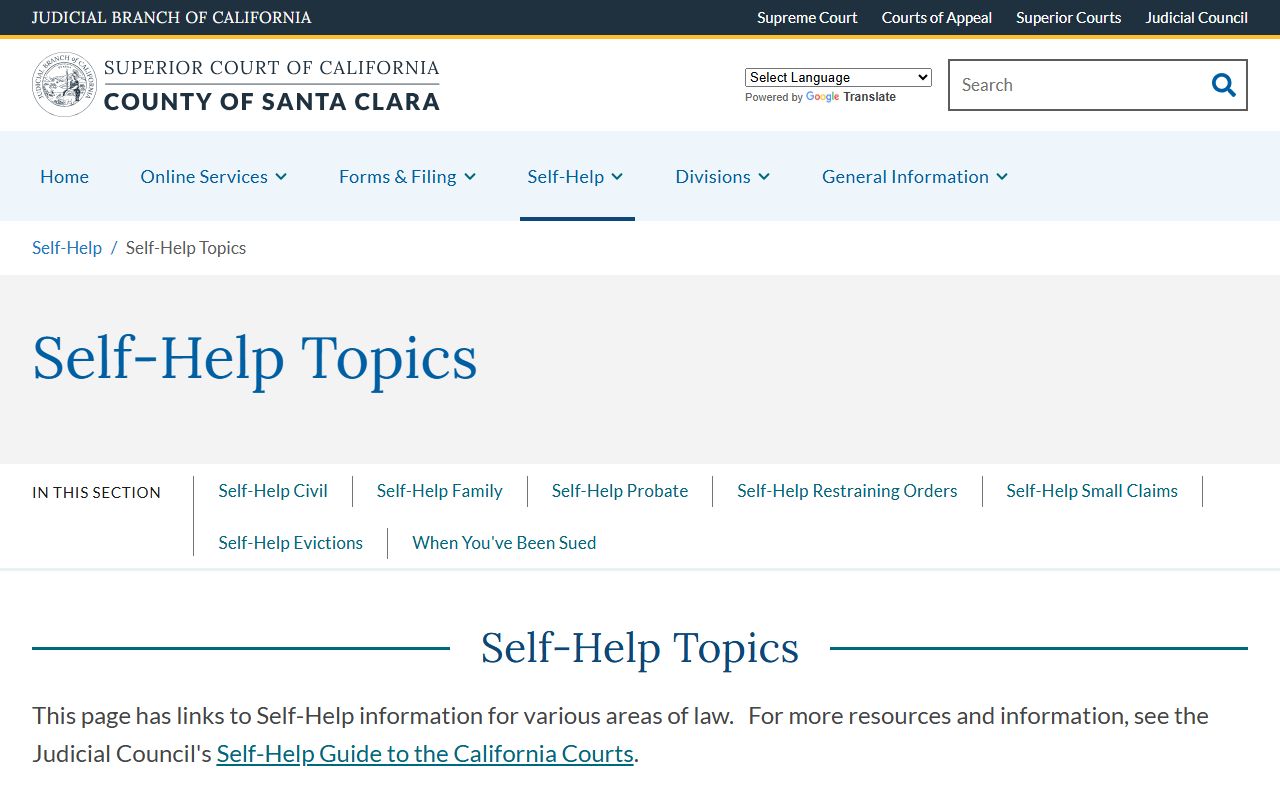
From this landing point the user can drill into traffic or criminal self-help, which is where the official warrant guidance for Santa Clara County lives.
Search-Field Table for the Warrant Lookup
The Traffic Case Info Portal is the search tool the court points people to first. The portal returns a case status string, and that string is where the warrant language shows up. The fields used in the lookup are short. Most users only need a case number or a name. The table below comes straight from the court's documented warrant search flow.
| Field Label | Type | Required | Notes |
|---|---|---|---|
| Traffic case number | Text | Preferred | Most reliable input. Use the citation or court case number. |
| Defendant / citation information | Text | Optional | Name or citation details used when no case number is on hand. |
| Search | Button | Yes | Submits the portal query. |
| Case status | Result field | N/A | Shows delinquency or warrant language if a warrant has issued. |
| Payment status | Result field | N/A | Example value: Payment state Due. |
For criminal warrants the Case Information Portal at portal.scscourt.org uses a different field set. A user can search by case number, party name, and date of birth, or by party name plus filing month and year for cases filed in 2004 or later. Older criminal cases require a courthouse microfiche check.
Reading Warrant Status in Santa Clara County Case Results
The court gives one example string that signals an active warrant in a traffic case. The text is short. It tells the reader the case is delinquent, the date a warrant issued, and the payment state. A user should treat this language as the official sign that a warrant exists. The same status block is what a clerk will read off when verifying a warrant by phone.
Sample warrant status language: "Case is delinquent. Warrant issued on [date]. Payment state: Due." This is the official traffic warrant indicator used in Santa Clara County Superior Court case results. If a person sees this text on their case record, a warrant has issued and must be cleared.
That single string carries three pieces of information. First, the case is delinquent. Second, a warrant has been entered against the defendant on a specific date. Third, the payment due on the underlying citation has not been paid. All three pieces must be addressed when the warrant is cleared. Paying the citation alone may not lift the warrant if a court appearance is required.
Sample Santa Clara County Warrant-Record Field Inventory
A warrant record viewed through a Santa Clara County case file does not look like a stand-alone warrant database row. It lives inside the case docket. The fields a user will see, when public, are listed below. Some fields appear only on certain warrant types. Search warrants and juvenile warrants are usually sealed or restricted.
| Field | What It Shows |
|---|---|
| Case Number | The court case the warrant belongs to. Use it for clerk contact and copy requests. |
| Charge | The underlying citation or criminal charge that led to the warrant. |
| Court Location | Which Santa Clara County courthouse ordered the warrant, such as Hall of Justice or Morgan Hill. |
| Warrant Issue Date | The date the bench officer or judge signed the warrant. |
| Warrant Type | Arrest warrant, bench warrant, search warrant, probation hold, or other category. |
| Bail Amount | The set bail or forfeit amount that may clear the warrant in some cases. |
| Status | Active, recalled, served, or quashed. A recalled or quashed warrant is no longer in force. |
The court explicitly limits what is public. Probation reports, victim names and addresses, financial and medical information, juvenile case file material, and sealed search warrants are not viewable through the portal. A user who needs more detail than the portal shows must request copies from the correct clerk division by mail or in person.
Types of Santa Clara County Warrants
Warrants in Santa Clara County fall into several categories. Each is issued for a different reason and each is cleared in a different way. The list below is drawn from the court's own warrant guidance and from how warrants surface in case records.
- Arrest warrant. A criminal order signed by a judge that authorizes a peace officer to arrest a named person. Used for new criminal complaints and for charges where the defendant has not been taken into custody.
- Bench warrant. Issued from the bench, often for failure to appear, contempt of court, or noncompliance with a court order. Bench warrants are the most common warrant a public user will see on a Santa Clara County case docket.
- Search warrant. Authorizes a peace officer to search property or seize evidence. Often sealed until executed or unsealed by court order, so the warrant itself may not appear in public results.
- Probation or parole warrant. A hold issued when a person on supervision is alleged to have violated terms. Often paired with a no-bail status until the supervision court rules.
- Juvenile warrant. Restricted by juvenile confidentiality rules. Public users will not see juvenile warrant records through the standard portal.
- Sealed indictment or sealed warrant. Not public until unsealed or until an arrest is made. Used in grand jury or sensitive investigations.
Note: A bench warrant for a missed traffic case may be cleared by paying the underlying citation and any added penalties; a felony bench warrant almost always requires a court appearance.
Corporate Summons in Santa Clara County
A corporate summons is not a warrant against a person. It is a court order telling law enforcement to bring an officer of a company or corporation to court. The Superior Court covers corporate summons on the same traffic warrants page. The order applies when a citation or court matter names a business and the business fails to respond.
To clear a corporate summons, the court directs the named officer or the company's legal representative to contact the court that issued the order. The clerk will provide bail information, proof of correction instructions, or a court date. The summons stays open until one of those paths is completed. Treat a corporate summons with the same urgency as a personal bench warrant. The court can hold an officer in contempt if the company keeps ignoring the order.
The court's restraining order self-help page is loosely related to this topic because violations of a restraining order can also trigger arrest warrants. See the source at santaclara.courts.ca.gov/self-help/self-help-restraining-orders.
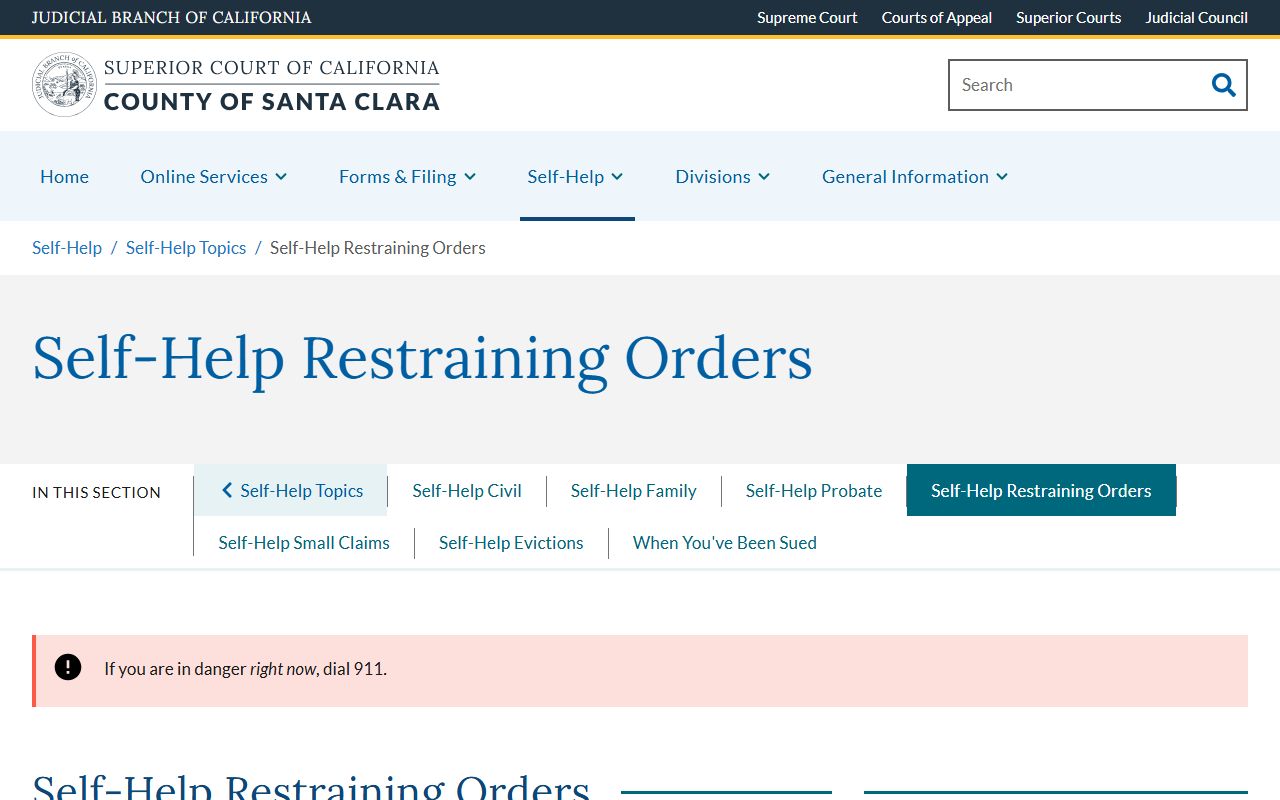
Restraining order violations are a common path to a fresh bench warrant in Santa Clara County, which is why this page sits next to traffic and criminal warrant guidance in the Superior Court's self-help library.
How to Clear a Santa Clara County Warrant
The Superior Court publishes a short numbered process for clearing a warrant. The steps below come from that guidance. The court will not tell a person not to come in. It expects voluntary action.
- Identify the court that ordered the warrant. The case docket and case number show which courthouse signed the warrant.
- Contact that court in person. The clerk's counter is the right channel, not the sheriff's front desk.
- In most cases the clerk gives a court date on which the warrant can be addressed by the judge.
- Appear in court on the scheduled date. Bring identification and any proof of payment, correction, or attendance the citation required.
- If you do not appear, the court warns a new warrant may issue and additional penalties may apply.
- Some warrants can be cleared by forfeiting bail or paying what is owed without going to court. Other warrants require an appearance, especially criminal bench warrants.
For criminal warrants, a person should plan to surrender during court hours so a judge can hear bail or release matters the same day. Surrendering after hours often means a longer hold in the Main Jail before the next available calendar. The court does not promise a same-day release on any warrant.
When You Need a Lawyer for a Santa Clara County Warrant
A felony bench warrant or any warrant tied to a serious criminal case calls for a lawyer before the person walks into court. The Santa Clara County Public Defender's Office is available for people who qualify financially. The Public Defender page names Damon Silver as Acting Chief Public Defender, selected in December 2024. The office has covered indigent criminal defense in Santa Clara County for decades.
Court-appointed counsel is granted at arraignment if the defendant is financially eligible. A judge reviews income and assets and makes the call. People who do not qualify can hire private criminal defense counsel; the Santa Clara County Bar Association runs a lawyer referral service that probate and family pages also point to. For a misdemeanor or traffic warrant a person can usually handle the clear-and-appear steps without counsel, but a lawyer is wise if there is any chance of jail time.
The Public Defender's Office does not handle traffic infractions in most cases. Traffic infractions are not custodial offenses under California law unless they escalate. A driver with multiple failures to appear on traffic citations should still call the court or seek limited-scope advice before surrender, because added penalties stack up fast.
Santa Clara County Courts That Handle Warrants
Four Santa Clara County courthouses cover the bulk of warrant activity. Criminal warrants are concentrated at the Hall of Justice in San Jose. Traffic warrants are handled at the Family Justice Center across from the downtown civil cluster. South County traffic and criminal go through Morgan Hill. North County criminal goes through Palo Alto. The court's courthouse locations page lists every building.
Hall of Justice
190 West Hedding Street
San Jose, CA 95110
Criminal Clerk: 408-808-6611
Departments 23-54 (Criminal)
Family Justice Center Courthouse
201 North First Street
San Jose, CA 95113
Family Records: 408-534-5711
Departments 60-79 (Family, Juvenile Dependency, Drug Court, Traffic, Self-Help)
South County Morgan Hill Courthouse
301 Diana Avenue
Morgan Hill, CA 95037
Criminal: 408-695-5014
Traffic: 408-556-3000
Departments 105-110
Palo Alto Courthouse
270 Grant Avenue
Palo Alto, CA 94306
Phone: 650-462-3810
Departments 84-89 (Criminal, North County)
For a fuller breakdown of these buildings see the Superior Court page. For criminal case background tied to a warrant, see criminal records. For traffic citation status, see traffic court records.
Bench Warrants for Missed Santa Clara County Court Dates
A missed court date is the most common cause of a bench warrant in Santa Clara County. California law gives the court several tools to act on a failure to appear. For infractions, Penal Code section 853.7 makes willful failure to appear after a written promise to appear a misdemeanor. For felony cases, Penal Code section 1320 treats failure to appear after release on own recognizance as a separate criminal offense. For traffic citations, Vehicle Code section 40508 makes it a misdemeanor to break a written promise to comply with the citation.
That means a person who skips one court date can end up facing a new charge on top of the original ticket or case. Santa Clara County treats those new charges seriously because the failure-to-appear count itself can carry jail time. The court can also impose civil assessment fees and add the matter to the state's tax intercept program.
Note: A defendant who misses a court date for a legitimate reason should contact the clerk as soon as possible; the court has discretion to recall a bench warrant before it is served.
Why There Is No Public Active-Warrant List for Santa Clara County
Research into Santa Clara County warrant resources turned up no public active-warrant list or "most wanted" warrant database run by the Sheriff's Office or the Superior Court. Warrant status surfaces inside individual case records on the court's portals, not on a sheriff search page. The court's official warrants page focuses on traffic warrants and on the clear-the-warrant process, not on a name search of every active warrant in the county.
That gap is normal in California. Sheriff offices in most California counties do not publish a full active warrant list because the data is sensitive and because publishing it can interfere with active arrests. A person who needs to verify whether they have a warrant should call the court that holds the case, contact the Santa Clara County Sheriff's Office for a records check, or consult an attorney who can pull court records on their behalf.
The Superior Court's Collaborative Courts page is worth noting in this context because collaborative courts are often the path a defendant takes after a warrant is cleared and a treatment program is offered.
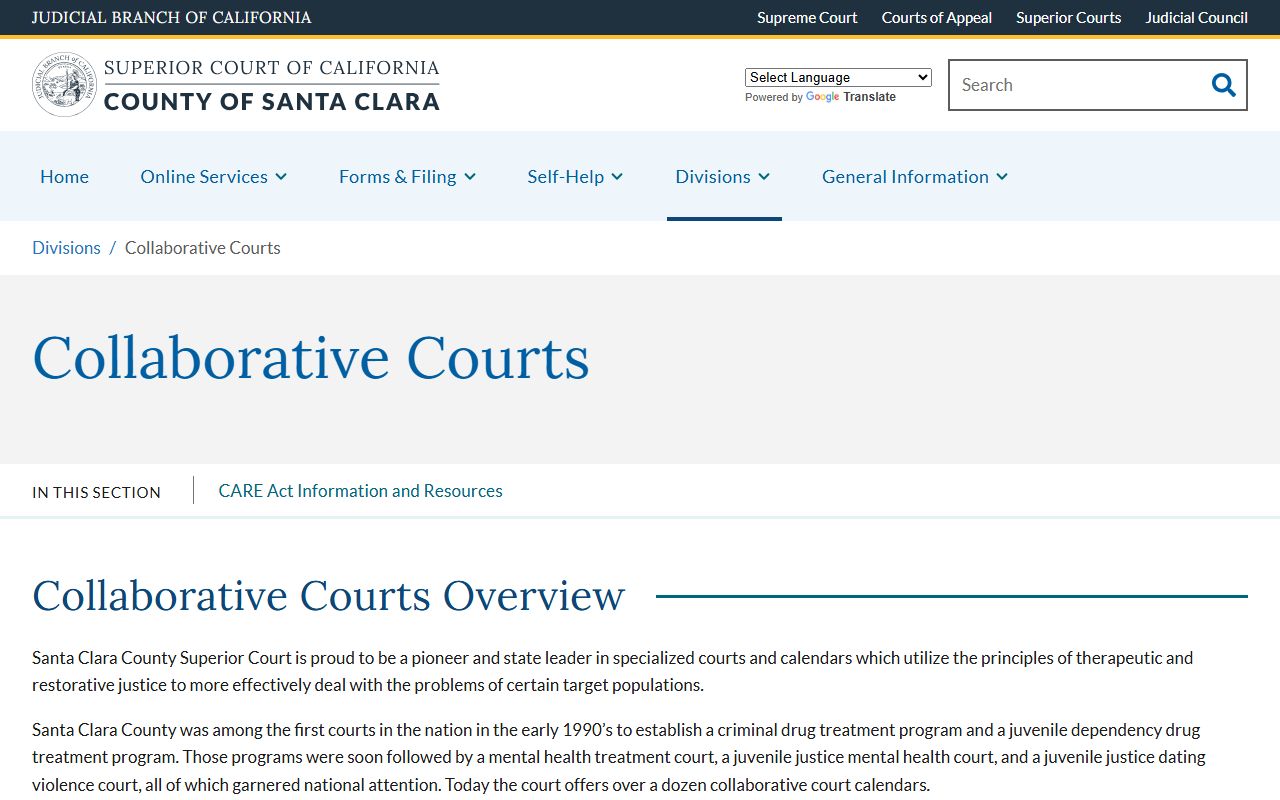
Drug court, mental health court, and other collaborative calendars in Santa Clara County offer alternatives to jail time for people whose warrant traces back to a treatable issue, which is a reason to clear the warrant through the court rather than wait for an arrest.
For broader case history see Santa Clara County court records. For booking status after an arrest on a warrant, see inmate records. For clerk contact details across the county, see Clerk of the Superior Court.