
Searching Santa Clara County Criminal Case Records
The Superior Court of California, County of Santa Clara, runs the public Case Information Portal at portal.scscourt.org. The portal covers civil, small claims, probate, some family cases, traffic and local ordinance matters, and criminal cases. For criminal records, the portal holds the case index for matters filed in 2004 or later. Older cases live on microfiche at the Clerk's Office and cannot be searched online.
The court's own criminal case records guidance says a person must have the case number to see or copy public criminal records. The portal is the fastest way to find that case number. Once a record is open, the docket shows charge codes, court dates, the department number, the assigned judge, and the disposition. Filings and pleadings are not generally available online. Most criminal documents must be viewed at a public access terminal in the courthouse or requested by mail.
Criminal records are also visible on the public terminals inside the Hall of Justice at 190 West Hedding Street, San Jose. The clerk's counter helps with copy requests, fee questions, and the microfiche pull list for pre-2004 cases. Counter hours run Monday through Thursday from 8:30 a.m. to 3:00 p.m. and Friday from 8:30 a.m. to 12:00 p.m.
The 2004-and-Later Criminal Case Index
The portal lets a user pull a criminal case number two ways. Both are listed in the court's own criminal records page. The first uses defendant name plus date of birth. The second uses defendant name plus the month and year the case was filed. Either combination returns the case number, and from there the docket and minute orders open up.
Search input is strict. A misspelled name, a wrong middle initial, or a stale DOB returns no hits. If the defendant has used multiple names, search each one. The portal does not let the public search by charge code, by judge, or by arresting agency. Those filters are internal to the court.
| Field Label | Type | Required | Notes / Format |
|---|---|---|---|
| Case Number | Text | Preferred | Use the exact court case number when known. Most reliable search key. |
| Defendant Name | Text | Yes for name search | Last name and first name. Spelling must match court records. |
| Date of Birth | Date | Conditional | Required with defendant name for 2004-and-later index. |
| Filing Month / Year | Month-Year | Alternative | Use with defendant name when the DOB is not known. |
| Search | Button | Yes | Submits the query and returns the case index. |
If the search returns more than one match, open each result and compare DOB, case type, and filing date before pulling copies. Two defendants in the county can share a common name.
Pre-2004 Microfiche Search
Cases filed before 2004 are not in the online index. The Clerk's Office holds them on microfiche at the Hall of Justice. To pull a pre-2004 criminal case, a requester needs the defendant's full name, the date of birth, and the filing year. Without those three, the clerk cannot run the search.
A search fee applies when a clerk search takes longer than ten minutes. The court counter handles the microfiche pull in person. Mail-in requests for old cases work too, but turnaround takes longer, and a check should cover both the search fee and the copy charge. For any case where the page count is unknown, the court allows the memo line to read "not to exceed $10.00" so the clerk can pull what is needed without bouncing the check.
Charges vs. Convictions
Many people read a criminal record and assume every charge is a conviction. That is wrong. A charge is the accusation filed by the District Attorney. A conviction is the judgment entered by the court after a plea or verdict. Both show up in the same court file, but the legal meaning is not the same.
| Charge | Conviction | |
|---|---|---|
| Stage | DA files a complaint, information, or indictment. | Court enters a guilty plea, no-contest plea, or jury verdict. |
| Burden of Proof | Probable cause to bring the case. | Beyond a reasonable doubt at trial, or a knowing plea. |
| Where It Appears | Complaint, arraignment minute order, docket. | Sentencing minute order, judgment, abstract of judgment. |
| Public Record | Yes, on the docket. | Yes, in the sentencing order. |
| Final Effect | May be dismissed, reduced, or amended. | Triggers sentence, fines, probation, or custody. |
Charges can be amended or dropped at any stage. The docket shows the path. A line that reads "Count 1 dismissed, plea to Count 2 as misdemeanor" means the case ended on the second count alone. Pulling only the original complaint without the disposition can give a false picture.
Sealed vs. Expunged
California does not erase adult records the way television suggests. Two separate statutes drive most post-case relief in Santa Clara County. The first is dismissal after probation. The second is arrest sealing when no conviction occurred. They look similar in casual talk but do different things.
A direct read of the statute helps. The Legislature posts the full text of Penal Code section 1203.4 online, including the dismissal language and the conditions.
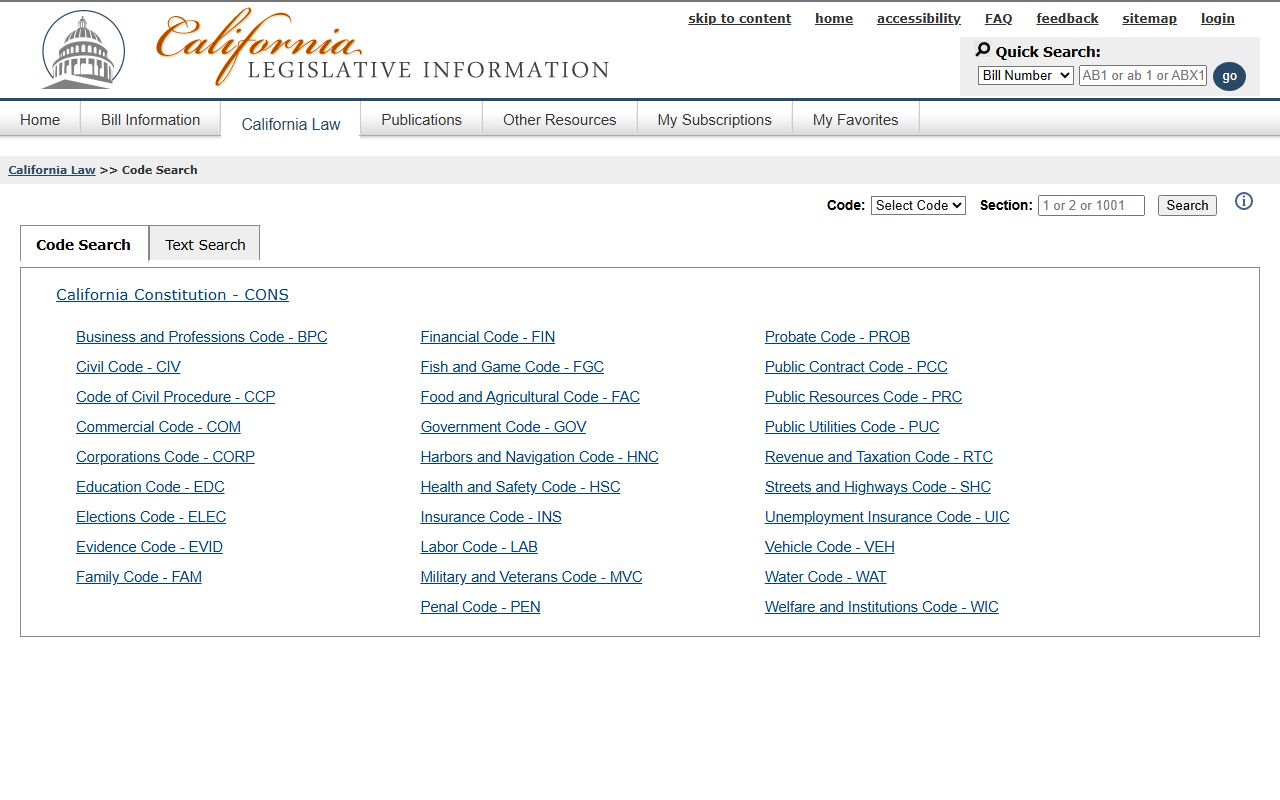
Section 1203.4 sets out who qualifies, what the court does, and the carve-outs for certain offenses and government background checks. The arrest-sealing path is set by a different statute, Penal Code section 851.91.
Section 851.91 covers arrests that did not lead to conviction. A petition is filed in the court that handled the arrest. If granted, the arrest record is sealed for most purposes.
| Dismissal (PC 1203.4) | Arrest Sealing (PC 851.91) | |
|---|---|---|
| When Used | After probation on a conviction is done. | When the arrest did not result in conviction. |
| What It Does | Sets aside the plea or verdict and dismisses the case. | Seals the arrest record from most public view. |
| Court Record | Case file stays; docket reflects the dismissal. | Arrest is treated as not having occurred for most uses. |
| Limits | Some licensing, firearm, and DOJ uses still see it. | Some law-enforcement and prosecution uses still see it. |
| Where to File | Court that handled the conviction. | Court or agency tied to the arrest. |
Dismissal is not the same as erasure. A 1203.4 case can still be reported on some background checks, and the court file still exists. Juvenile sealing follows its own track under the Welfare and Institutions Code and the juvenile rules. See the juvenile statute at WIC section 827.
WIC 827 keeps juvenile case files confidential except for authorized persons, with court permission required for outside inspection. That standard differs in real ways from adult relief, so adult and juvenile petitions should not be mixed.
What Criminal Documents Are NOT Public
Even when a criminal case is public, several documents inside the file are not. The Superior Court's own criminal records page lists the carve-outs. They show up in nearly every adult case, so a copy request that names them will come back denied.
- Arrest reports or documents listing victim name, address, or phone number.
- Probation reports prepared for sentencing.
- Domestic violence protective orders pulled from the criminal file.
- Own Recognizance release reports.
- Criminal history information held by the Sheriff or California DOJ.
- Financial and medical information filed in support of motions.
- Sealed filings under court order.
Sealed filings follow the procedure set by the state Rules of Court. The Judicial Council posts the rule at Rule 2.550, which states the presumption that records stay open unless a court makes specific findings.
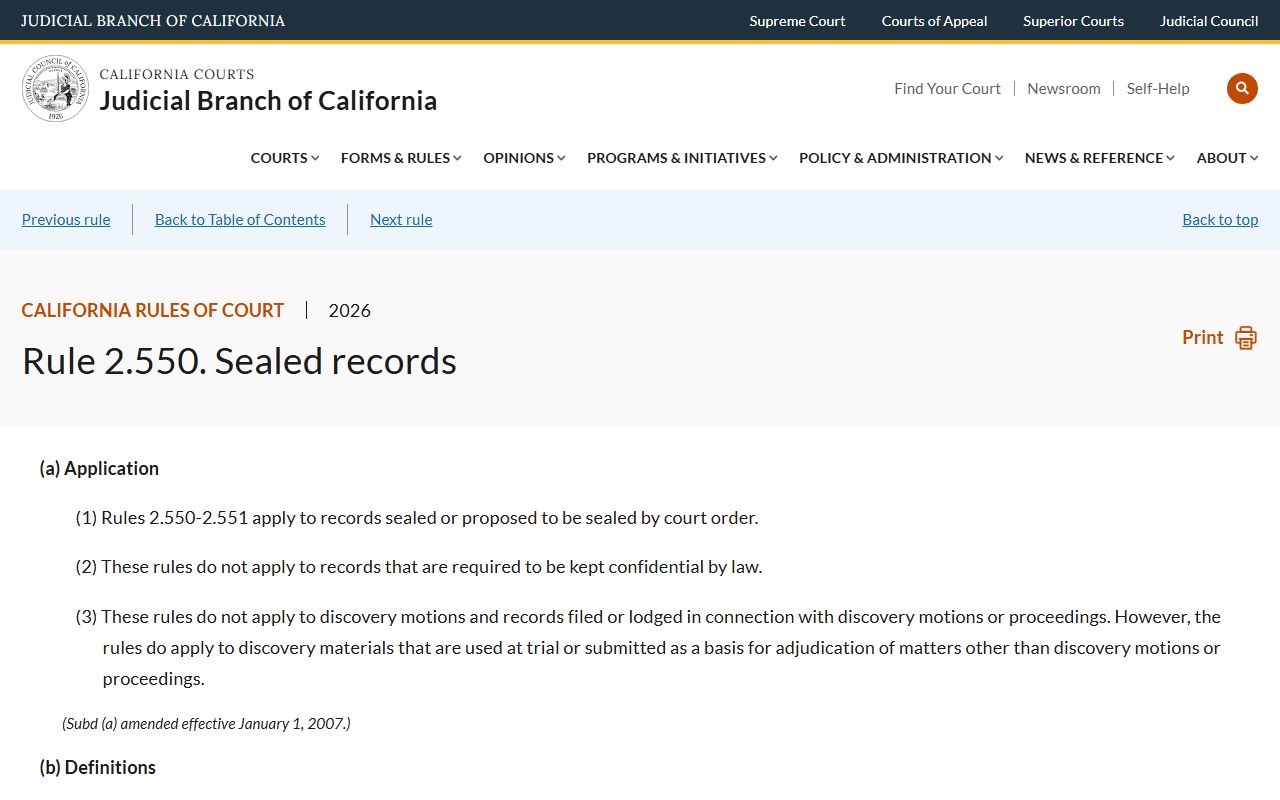
Rule 2.550 controls when a court may seal an entire record or a single filing. Without those findings, the file stays open even where a party objects. Juvenile records get a separate framework under Rule 5.551.
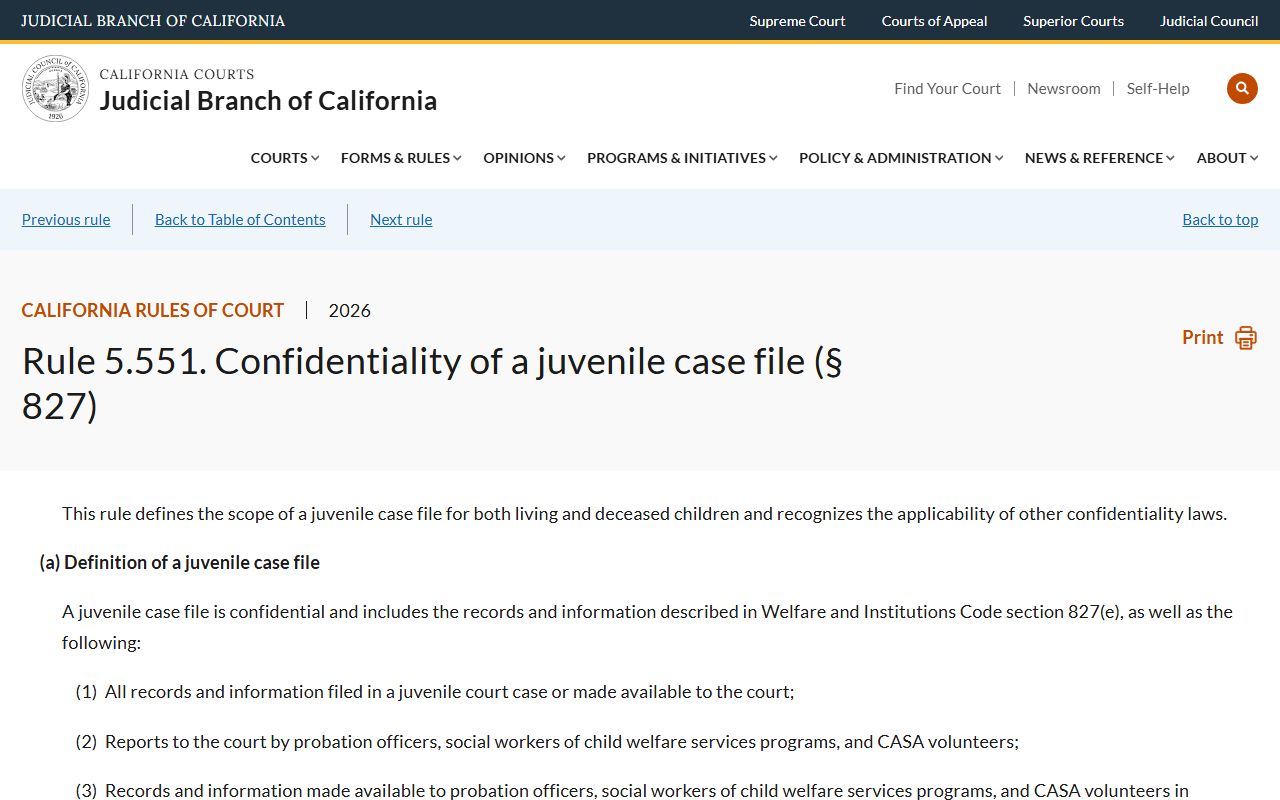
Rule 5.551 carries the juvenile confidentiality rule into court practice. It pairs with WIC 827 and shapes who can see a juvenile file and how.
How to Request a Certified Copy
Certified copies are needed for immigration cases, sentencing review, employment vetting that demands court-certified proof, and many out-of-state matters. The criminal clerk handles them by mail and at the counter. The steps below match the court's criminal records guidance.
- Pull the case number from the Case Information Portal. The clerk cannot process a copy request without it.
- Write a short letter that names the defendant in full and gives the defendant's date of birth. The full name and DOB match the case to the right file.
- Name the document by type and date. Examples: "Minute order for hearing on 03/14/2018," "docket," "sentencing order," or "filed criminal complaint." Vague requests come back unfilled.
- Include payment by check or money order payable to "Clerk of the Superior Court." If the page count is unknown, write "not to exceed $10.00" on the memo line so the clerk can fill the order without bouncing the check.
- Add a self-addressed stamped envelope. The clerk uses it to mail the certified copy back. Without an SASE, the file may sit until contact is made.
- Mail the packet to the criminal clerk at the courthouse that holds the case. Hall of Justice handles most San Jose criminal files; South County and Palo Alto handle the cases filed at those locations.
Turnaround varies with clerk workload. Plan on several weeks during heavy filing months. A search fee may also apply if the clerk's search runs longer than ten minutes.
Criminal Filing Locations by City
Santa Clara County splits criminal filings by region. A misdemeanor or felony arrest is sent to the courthouse tied to the city of arrest, not always the city where the defendant lives. Knowing which courthouse holds the file saves a trip.
| Courthouse | Cities Served | Address |
|---|---|---|
| Hall of Justice | San Jose, Milpitas, Los Gatos, Saratoga, Monte Sereno, Santa Clara | 190 West Hedding Street, San Jose, CA 95110 |
| South County Morgan Hill Courthouse | San Martin, Morgan Hill, Gilroy | 301 Diana Avenue, Morgan Hill, CA 95037 |
| Palo Alto Courthouse | Cupertino, Mountain View, Palo Alto, Sunnyvale | 270 Grant Avenue, Palo Alto, CA 94306 |
The Hall of Justice holds Criminal Departments 23 through 54 and is the busiest of the three. South County criminal sits inside the Morgan Hill courthouse alongside traffic. Palo Alto holds Criminal Departments 84 through 89. Misdemeanors, felonies, and probation review hearings track to the same building where the case was first filed.
Arrest Records vs. Court Records
An arrest happens before any court case is opened. The arrest report is written by the arresting agency, normally the Sheriff or a city police department. The court file does not start until the District Attorney files a charging document. Both records exist, but they live in different offices and follow different access rules.
| Arrest Record | Criminal Court Record | |
|---|---|---|
| Holder | Sheriff's Office or arresting police agency; DOJ for state history. | Superior Court Clerk's Office (criminal division). |
| Created When | At booking, after the arrest. | When the DA files a complaint, information, or indictment. |
| Contents | Booking data, charges at arrest, mugshot, narrative report. | Pleadings, motions, minute orders, sentencing, judgment. |
| Public Access | Narrow. Many fields are restricted under Government Code 7923.600. | Open under Rule 2.503, with named exclusions. |
| Where to Ask | Sheriff custody info line; DOJ for state rap sheet. | Criminal clerk at the holding courthouse. |
An arrest without a filed case will not appear in the court portal. Booking data may show up on the Sheriff's inmate search at the time of custody. Once released, the public booking record may be limited or removed. The court file shows only what the DA filed.
Santa Clara County District Attorney and Public Defender
The District Attorney's Office files criminal charges and runs the prosecution. The Public Defender's Office represents people who cannot afford to hire a lawyer. Both offices shape what shows up in a criminal record and how a case is resolved.
Santa Clara County District Attorney
Jeff Rosen, District Attorney (since 2011)
County of Santa Clara District Attorney's Office
da.santaclaracounty.gov
The DA's Office has over 640 employees, including 192 deputy district attorneys, and serves nearly two million residents. It is the largest prosecutor's office north of Los Angeles. The office prosecutes tens of thousands of cases each year and diverts thousands more.
Reform programs under Jeff Rosen shape what appears in many Santa Clara County criminal files. The DA lists race-blind issuing of charges, a Conviction Integrity Unit, a Brady Committee for officer credibility tracking, open-file discovery, a body-worn camera policy, and a Major Crime and Drug Trafficking unit that replaced the old Narcotics Unit in 2022. The office also runs diversion programs for low-level drug offenses, with later expungement support, and a Victim Services Unit and Family Justice Centers for survivors.
Santa Clara County Public Defender
Damon Silver, Acting Chief Public Defender
Office of the Public Defender, County of Santa Clara
pdo.santaclaracounty.gov
Damon Silver was selected as Acting Chief Public Defender in December 2024 after the retirement of Molly O'Neal. He has been a public defender for his full 30-year legal career, with 28 of those years at the Santa Clara County Public Defender's Office.
The Public Defender represents indigent defendants in adult criminal, juvenile justice, dependency, mental-health, and post-conviction matters. The court appoints counsel at the first criminal appearance when a defendant qualifies. The Alternate Defender's Office and Independent Defense Counsel Office handle cases that conflict out of the Public Defender.
Record-Clearing in California
Two state statutes carry most adult record-clearing work in Santa Clara County. Penal Code 1203.4 sets out dismissal after a completed term of probation. Penal Code 851.91 sets out sealing of arrest records where no conviction was entered. Each one has its own petition, its own filing rules, and its own carve-outs.
Dismissal under 1203.4 does not delete the case. The court sets aside the plea or verdict and dismisses the accusation. The docket reflects the dismissal. Some uses still see the prior conviction, including state licensing boards, certain firearm rules, and federal background checks. The case can also still count for prior-conviction sentencing on a future case.
Sealing under 851.91 reaches the arrest itself, not a conviction. It applies when an arrest did not result in conviction, when a case was dismissed without a guilty finding, or when an acquittal was entered. A granted petition lets the petitioner answer most questions about the arrest as if it never happened. Limited law-enforcement and prosecutor uses remain.
Petitions are filed in the court that handled the case. Santa Clara filers use the criminal clerk at the courthouse where the matter was heard. The Public Defender's Office and local legal aid groups can help eligible filers prepare the petition. Common reasons for denial include pending charges, probation violations, statutory exclusions, or unmet conditions tied to the original sentence.
Background Checks and Limits
The court file is not a full criminal history. A docket shows what was filed in that one case. A state rap sheet pulls all police contacts, arrests, and dispositions across California, plus prints from out of state where the DOJ has data. The two are not equal.
California restricts the DOJ summary criminal history. Only the person named in the record, certain employers under statute, licensing agencies, and law enforcement can pull the full state record. Members of the public cannot. A live scan request through an authorized agency is the standard path for a person to obtain their own DOJ record.
Employers running pre-employment background checks rely on consumer reporting agencies under the federal Fair Credit Reporting Act. Court-record copies pulled from Santa Clara County Superior Court can support that work, but they show only the cases filed in this county. For a multi-county picture, the requester needs each county court file plus, where statute allows, the DOJ summary.
Traffic and DUI work overlap with criminal records. DUI cases are criminal in California even though they often start with a traffic stop. For DUI-specific search steps and how a citation links to a criminal case file, see the Santa Clara County traffic court records page.