
California Public Records Act vs. Court Records
The split between agency files and court files trips up many requesters. The California Public Records Act, recodified at Government Code section 7920.000 and following, applies to county and city agencies. It does not control how the Santa Clara County Superior Court releases case files. Court access follows the California Rules of Court, common law presumptions, and case-specific confidentiality statutes. A request sent to the wrong office often gets bounced back, so the first task is to match the record to the right system.
| Topic | CPRA (Agency Records) | Court Case Files |
|---|---|---|
| Governing law | Gov Code 7920.000 et seq. | California Rules of Court 2.500, 2.503, 2.550, 2.551 |
| Who holds the file | Clerk-Recorder, Sheriff, DA, county departments | Superior Court of California, County of Santa Clara |
| Where to ask | Each agency has its own request channel | Court clerk or scscourt portal |
| Typical response | 10 days to determine, 14-day extension allowed | Varies by case type and copy queue |
| Online index | Limited for recorded land documents | Civil, family, probate, traffic, criminal docket data |
Most people who file a Santa Clara County public records request are after one of three things. They want a vital record, a recorded deed, or a court docket. Vital records and deeds belong to the Clerk-Recorder. Dockets and case files belong to the Superior Court. Police reports and jail records sit with the Sheriff and the District Attorney under CPRA. Knowing the right door saves weeks.
What Records the Santa Clara County Clerk-Recorder Maintains
The Santa Clara County Clerk-Recorder is the main county custodian for vital and recorded records. The office mission is to secure, preserve, and make available the county’s vital, business, and official records. The current Clerk-Recorder is Regina Alcomendras. The office sits at 110 West Tasman Drive, 1st Floor, San Jose, CA 95134. The Clerk-Recorder website at clerkrecorder.santaclaracounty.gov lists popular services and request channels.
- Marriage licenses and county ceremonies
- Birth, death, and marriage certificates
- Fictitious Business Name filings
- Notary oath and bond filings
- Real property recording and official record copies
- CEQA filings (under the ten-page e-filing limit)
- Paraprofessional and translator/interpreter registration
- DD-214 certified copy requests for veterans
The Clerk-Recorder does not hold divorce records. Those sit with the Superior Court. The FAQ points walk-in divorce requests to 201 North First Street, San Jose, CA 95113 (phone 408-882-2900) and mail requests to 191 North First Street, San Jose, CA 95113 (phone 408-882-2100). For everything else on the list above, the Clerk-Recorder is the right office. See the marriage and divorce records page for the family side of the system.
Santa Clara County Public Records Request – How to File
A clean request gets a faster answer. Each office reads requests through its own intake queue. Start by naming the record, the date range, and the format you want. Skip vague descriptions like “all records about my case.” A tight scope cuts search fees and helps the clerk pull the file on the first try.
- Identify the right agency. A deed or a marriage certificate goes to the Clerk-Recorder. A docket or case file goes to the Superior Court. A police report or jail record goes to the Sheriff. The CPRA covers the first and third; court rules cover the second.
- Check the online services first. The Superior Court’s online services page covers e-filing and the case portal. The Clerk-Recorder lists VitalChek and mail options on its site.
- Submit the request in writing. Email, U.S. mail, or an online form all work. Include your name, your contact info, a clear records description, and a phone number for clarifying questions.
- Agree to pay reasonable fees. State the dollar limit you accept so the office can stop and call if costs run higher than expected.
- Wait for the response. The agency has ten days to decide whether records exist and are disclosable. A 14-day extension is allowed for unusual circumstances.
- Pick up the records or pay the invoice. Some requests need a check or money order. Certified copies and large pulls may take longer than the initial response window.
Court file copies use a different intake. The Clerk of the Superior Court takes case copy requests through the case clerk for that division. Family Records Copy Request Form FM-1183 is the standard for divorce, custody, and support files. Bring the case number when possible. A $15 search fee applies if the clerk has to look the case up.
Public Records Fee Schedule
Fees come from two sources. Clerk-Recorder fees are set by the Board of Supervisors and published on the official fee schedule. Court copy fees come from the Government Code and the local court fee page. Both lists change from time to time. Always check the current schedule before mailing a check.
| Item | Amount |
|---|---|
| Birth certificate (Clerk-Recorder) | $34 |
| Death certificate | $26 |
| Marriage certificate | $19 |
| Standard marriage license | $80 |
| Confidential marriage license | $83 |
| Notary first signature | $38 |
| Court plain copy (per page) | $0.50 (Gov Code 70627(a)) |
| Court certification | $40 (Gov Code 70626(a)(4)) |
| Court search fee (no case number) | $15 (Gov Code 70627(c)) |
| Return check fee | $50 (Gov Code 71386) |
Note: Dissolution judgments use a $15 certification fee on the Family Records Copy Request Form, while other certified court copies run $40.
California Public Records Act Statutes
Three Government Code sections do most of the heavy lifting in a CPRA fight. The first names the act. The second sets up the public-interest test that lets an agency hold back sensitive material. The third draws the line around law enforcement files. Each section is short, and each one shows up in nearly every denial letter sent by a Santa Clara County agency.
The California Public Records Act short title is at Government Code section 7920.000. The page below shows the recodified text.
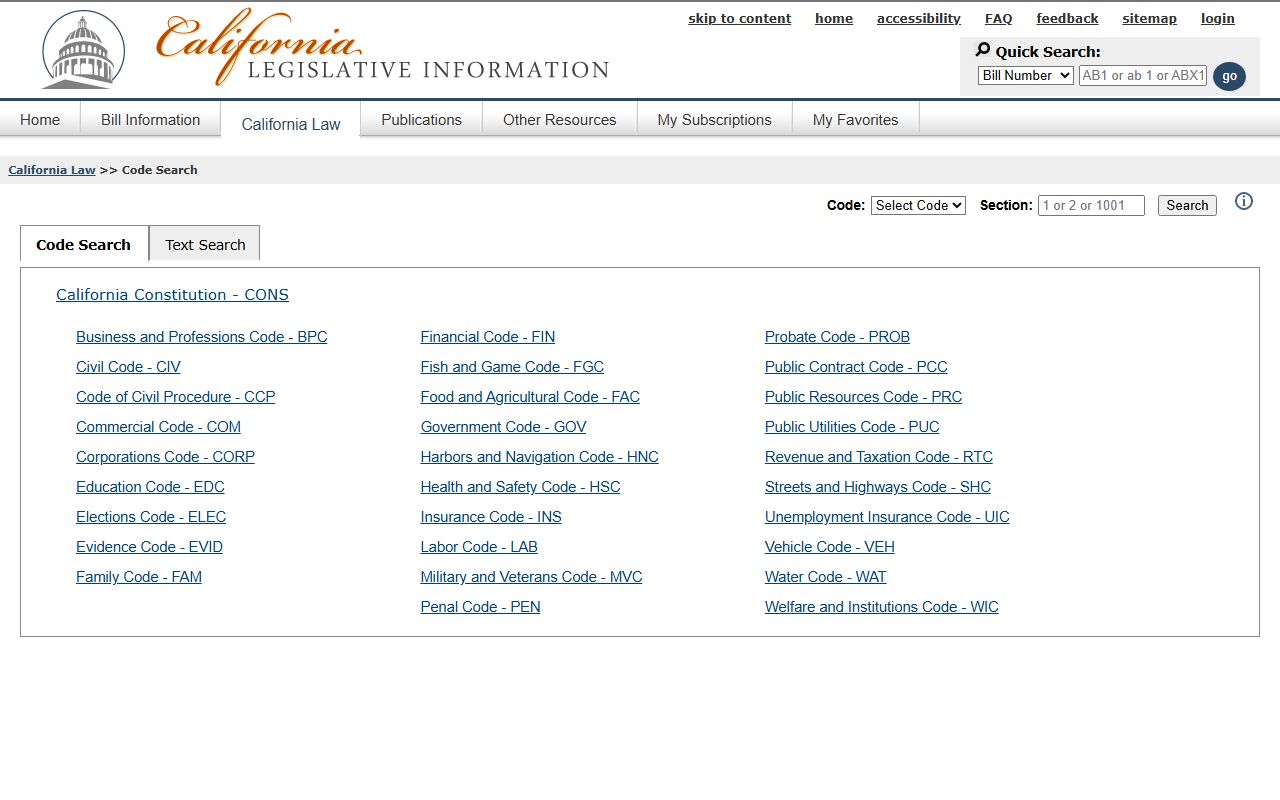
The recodification took effect on January 1, 2023 and pulled the CPRA into Division 10 of the Government Code. Requests addressed under the old code numbers still work, but new responses cite the 7920 series.
Public-interest balancing lives at Government Code section 7922.000. Agencies invoke this section when releasing the file would harm a private interest more than it would help the public.
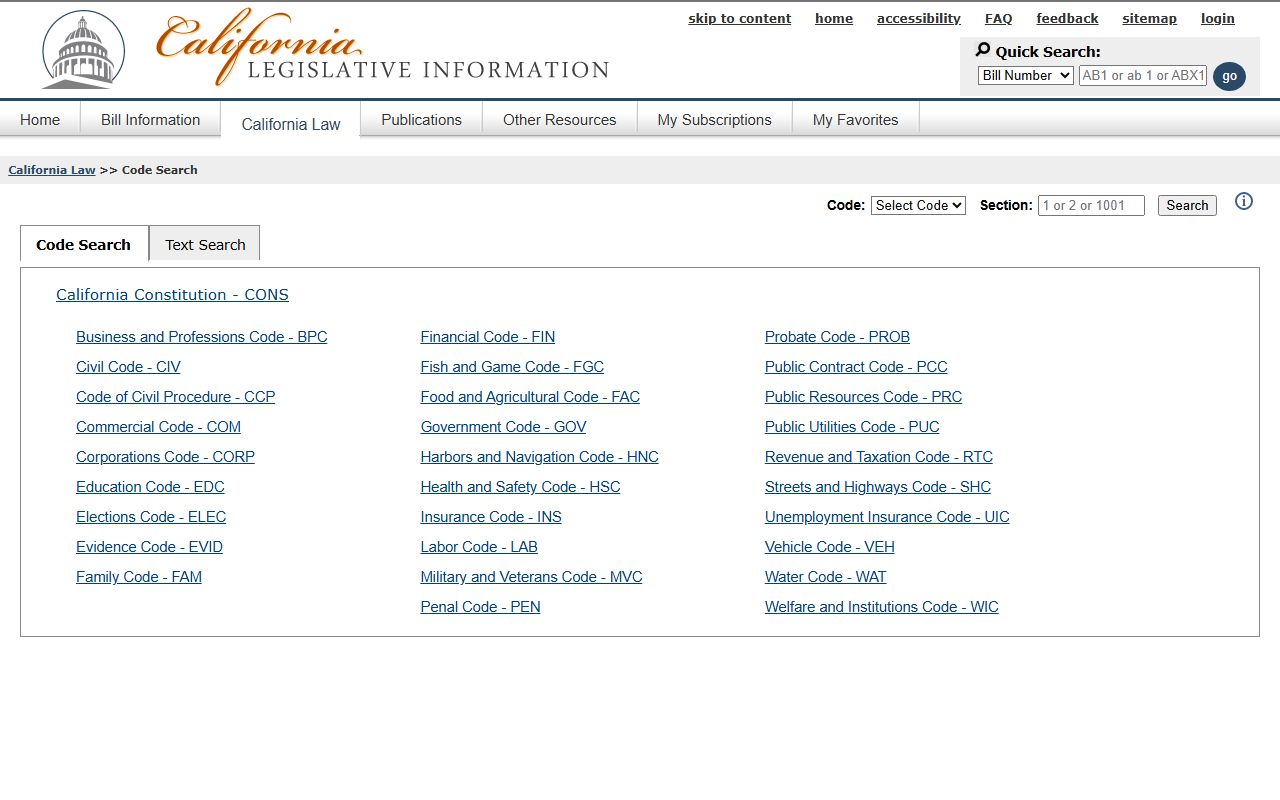
The balancing test is fact-specific. A requester who pushes back can ask the agency to spell out the exact harm and the exact public benefit it weighed.
Law enforcement investigatory records fall under Government Code section 7923.600. This section often blocks full release of Sheriff incident reports while still allowing the basic arrest log.
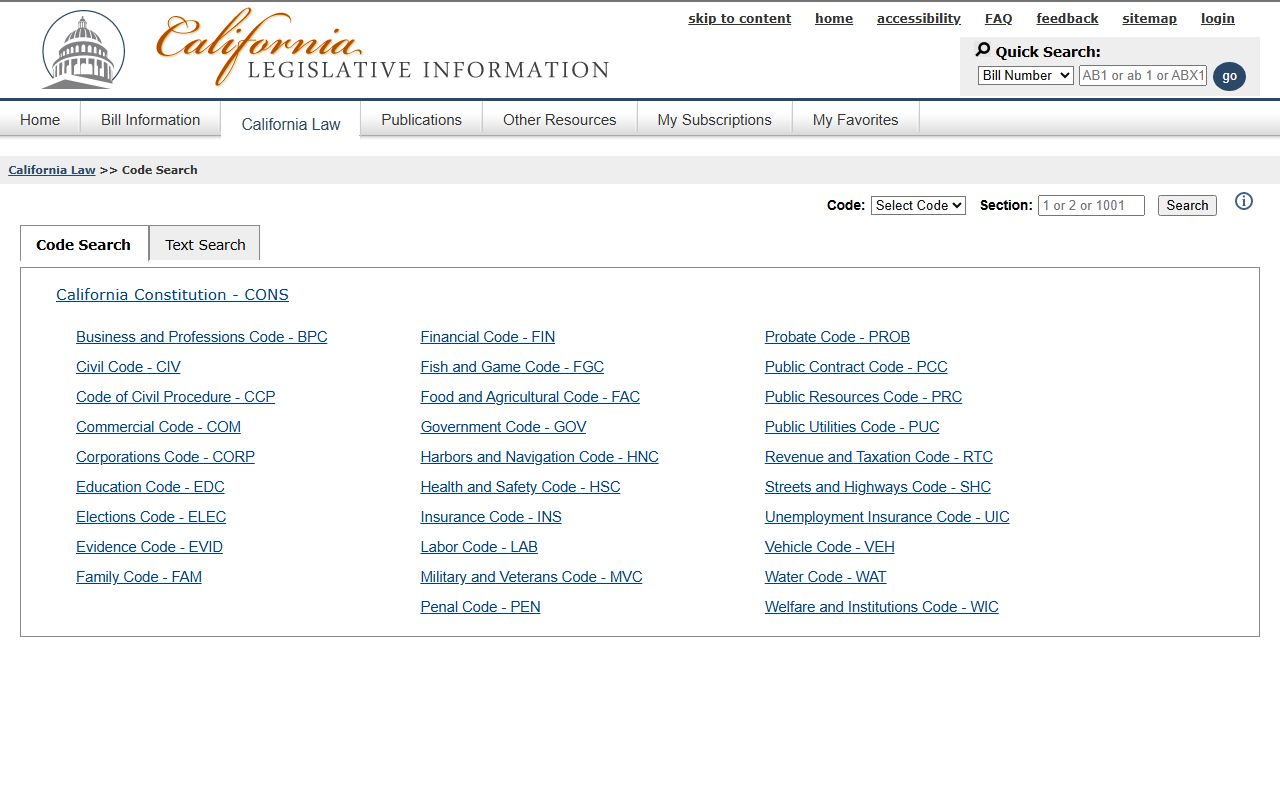
The Sheriff still must hand over the arrest narrative basics, the names of arrestees, and the time of release. For more on what crosses over, see the criminal records page.
Public Access to Court Records
Court records run on the California Rules of Court. The framework starts with Rule 2.500, which sets the purpose of electronic access. Rule 2.503 then splits remote access from courthouse access. Some case types can be searched from a home computer. Others require a trip to the public access terminal at the Downtown Superior Court. Santa Clara County’s portal at portal.scscourt.org covers civil, small claims, probate, some family, traffic, local ordinance, and criminal cases.
Sealing rules sit at Rule 2.550 and Rule 2.551. Both rules carry a presumption of openness. A party who wants a file sealed must show an overriding interest, a substantial probability of harm without sealing, and that the sealing order is narrowly tailored. The court must make those findings on the record. Bare requests for privacy do not meet the bar.
The court holds the file even after sealing. A motion to unseal can be filed in the same case. Visit the Superior Court page for the courthouse locations and division contacts.
Restricted Public Records in Santa Clara County
Many records look public but are not. The Santa Clara County criminal records page lists several categories that the public cannot copy from a criminal case file. Family law and probate add more layers. Below is a fast reference list pulled from the court’s own posted limits and from California statute.
- Juvenile case files (WIC 827 and California Rule of Court 5.551)
- Sealed adult court records (Rules 2.550, 2.551)
- Arrest reports that list victim name, address, or phone
- Probation reports and Own Recognizance reports
- Domestic violence protective orders held in a criminal file
- Criminal history (run through the Sheriff and DOJ, not the court clerk)
- Financial and medical exhibits filed in court
- Adoption files (Family Code confidentiality)
- LPS mental health conservatorship files
- Confidential marriage certificates – only a person listed on the certificate or a court order can buy a certified copy
Note: California does not erase most adult convictions; Penal Code 1203.4 dismisses the case for many purposes but does not wipe the record.
Online Records Limits
Santa Clara County took a step back from online land record indexes in late 2018. The Clerk-Recorder FAQ states that the online grantor/grantee index has not been available since November 5, 2018, under a directive from the County Executive. People who need to search recorded deeds and similar instruments must use the in-office process. The self-service portal at scccroselfservice.org still works for some services, but a disclaimer must be accepted on entry.
The Clerk-Recorder self-service portal opens with a disclaimer screen that limits how the data can be used.
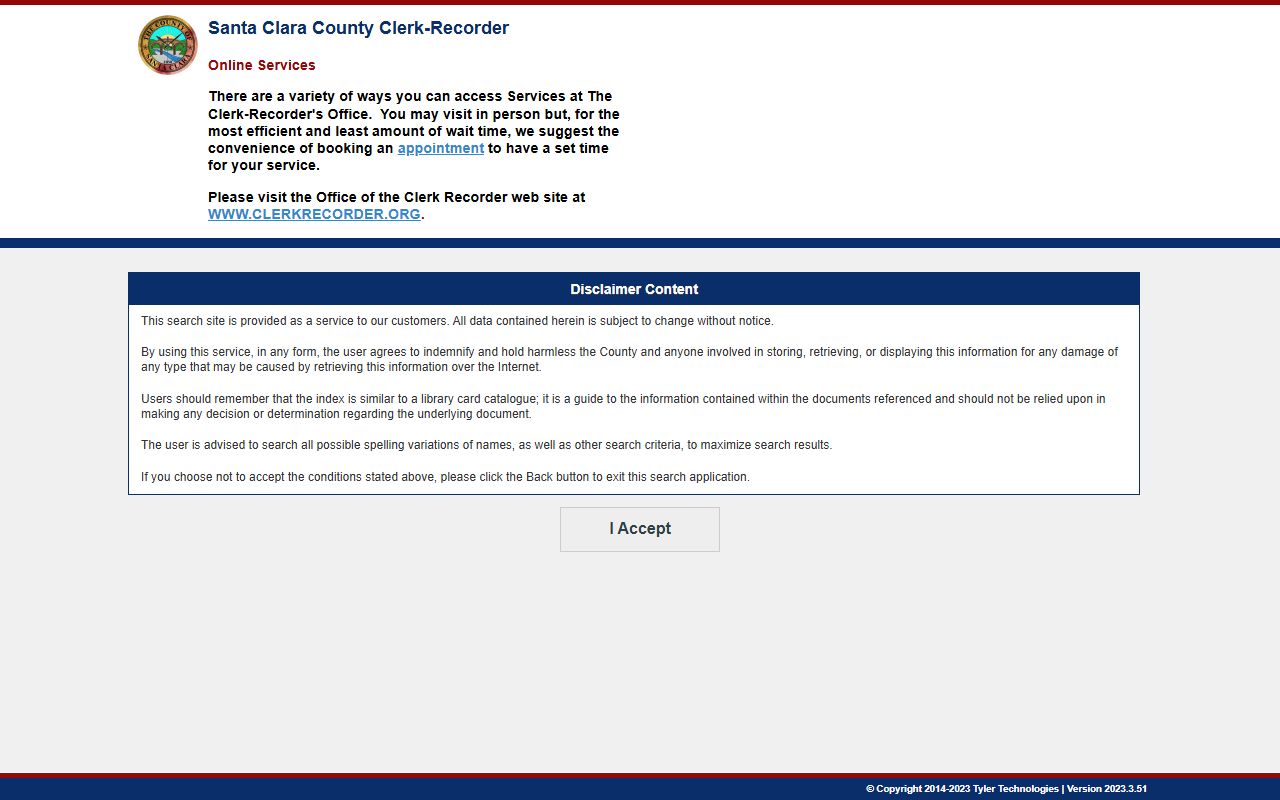
The portal handles vital record orders, marriage license starts, and some fee-paid copy services. Land record searches still need a counter visit or a written request with the document number.
How to File a CPRA Appeal
A denial is not the end of the road. Two paths exist. The first is agency review. The requester can write back, ask for the exact statute relied on, and ask for any segregable portion of the file. Many denials get cut back at this step because the agency releases a redacted version.
The second path is a court petition. The CPRA allows a writ of mandate in the superior court to force production. The agency must show why the record is exempt. A requester who wins gets attorney’s fees by statute. Court record disputes follow a different path: a motion or application is filed in the case that holds the record. The FAQ page covers the most common appeal questions.
Public Records Request Field Inventory
The Clerk-Recorder self-service portal and the court’s Family Records Copy Request Form each ask for a specific set of fields. The portal table reflects what the public-facing entry pages expose; some inner fields show only after the disclaimer is accepted.
| Field Label | Type | Required | Notes |
|---|---|---|---|
| Disclaimer acknowledgement | checkbox / button | Yes | User must proceed through portal disclaimer to reach search. |
| Search type | tab / menu | Unspecified | Portal splits official records, CEQA, and service applications. |
| Grantor / Grantee | text | Unspecified | Online grantor/grantee index has been off since 11/5/2018; in-office search remains. |
| Document number | text | Unspecified | Used for direct lookup when number is known. |
| Date range | date | Unspecified | Helps narrow large recorded record sets. |
The Family Records Copy Request Form is the most common form filed by people who want a divorce or custody file. The fields below come from the official PDF.
| Field Label | Type | Required | Notes |
|---|---|---|---|
| Today’s Date | date | Yes | Blank date line. |
| Requestor’s Name | text | Yes | Full name of the person asking for the copy. |
| Mailing Address | text | Yes | Street address for the return mail. |
| City | text | Yes | Mailing city. |
| Zip | text | Yes | ZIP code. |
| Case Number | text | If known | $15 search fee applies if no case number is given. |
| Case Name / Parties | text | Yes | Identifies the family case. |
| Document requested | text | Yes | Name the specific document or judgment. |
| Copy / certified copy | checkbox | Optional | $15 certification for dissolution judgments; $40 for other documents. |
| Payment | check / money order | Yes | Payable in advance to Clerk of the Superior Court. |
Santa Clara County Clerk-Recorder Contact
The Clerk-Recorder counter handles most non-court public record requests. Walk-ins, mailed requests, and appointment-based service all run from the same site. Bring photo ID for vital records.
Santa Clara County Clerk-Recorder
110 West Tasman Drive, 1st Floor
San Jose, CA 95134
Clerk-Recorder: Regina Alcomendras
Web: clerkrecorder.santaclaracounty.gov
For court case files, the Superior Court main mailing address is 191 North First Street, San Jose, CA 95113. Walk-in divorce records go to 201 North First Street. The court directory at 408-882-2100 routes calls by division.
Privacy and Redaction Rules
Even open records get redacted before release. Santa Clara County applies standard California redaction rules to every public file. Social Security numbers, full financial account numbers, victim contact information, medical records, and juvenile identifying details are blacked out by default. Court filings under California Rules of Court 1.20 and related family code sections push the same standard onto private parties who file documents.
Redaction does not mean withholding the whole file. The CPRA requires the agency to release any segregable portion. If a record can be cleaned and shared, it must be. A requester who suspects over-redaction can ask for a written explanation tied to a specific statute and section number. See the court records page for more on what the case file shows after redaction.