
Probate Court Location in Santa Clara County
All Santa Clara County probate matters are heard at the Downtown Superior Court in San Jose. The Probate Clerk's Office is in Room 107 of that building. Staff at the counter accept over-the-counter filings from self-represented parties, issue copies, and route calendar questions. The same office handles will deposits, conservatorship petitions, guardianship petitions, and decedents' estate petitions. Probate Examiners review files before each hearing and post their notes in Attorney Calendar Status Reports.
The court keeps separate phone lines for general probate help, the examiner team, and LPS Mental Health filings. Email is the fastest written channel for case questions. Use the probate court location page to confirm hours before visiting, since court closures can shift counter access. The Superior Court mailing address for all county courthouses is 191 North First Street, San Jose.
Probate Clerk's Office
Downtown Superior Court, Room 107
191 North First Street
San Jose, CA 95113
Probate: 408-882-2654
Probate Examiners: 408-882-2668
LPS Mental Health: 408-882-2651 (voicemail)
Email: ssprobinfo@scscourt.org
The court publishes a probate self-help landing page that gathers the case-type overview, forms, and clerk contacts in one place. See the probate self-help portal for the official menu of resources Santa Clara County maintains for probate filers.
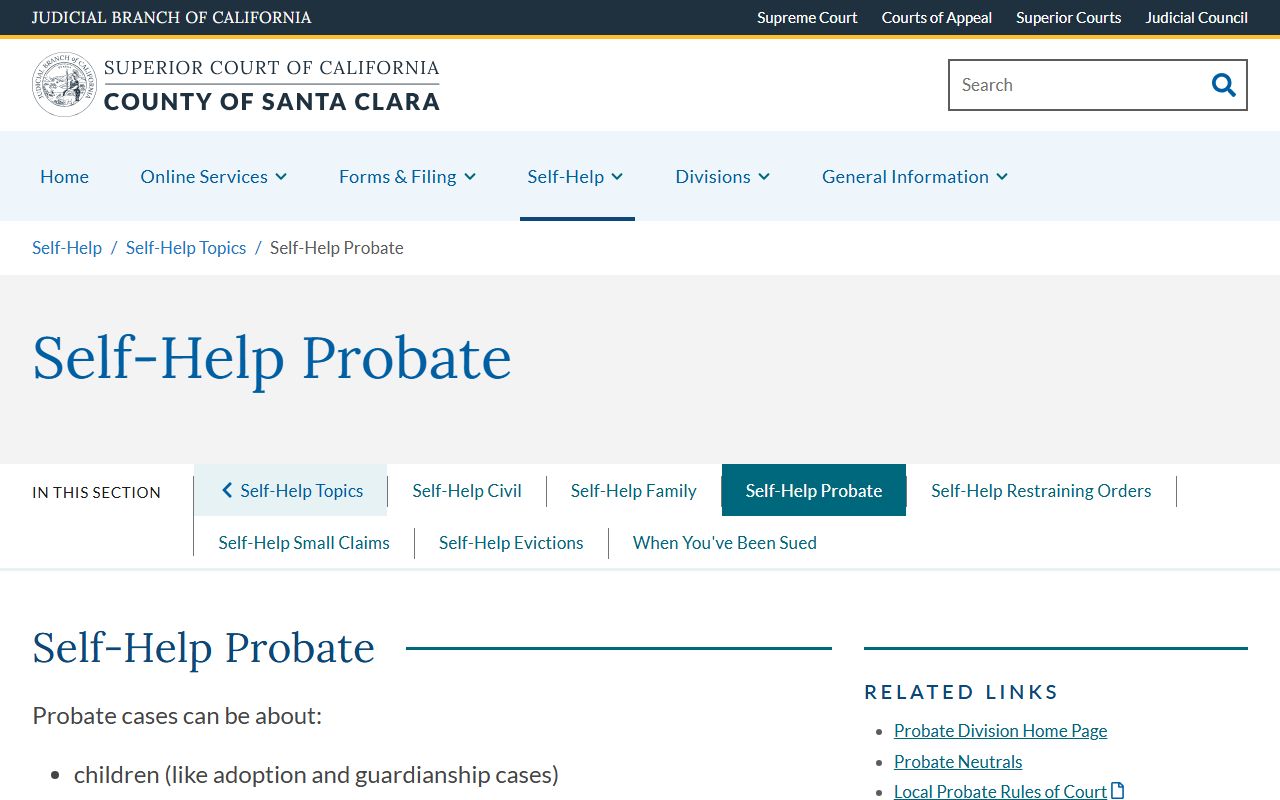
The page links to every probate topic the court treats as a public self-help service, from estate transfer to name change to conservatorship.
Probate Case Types in Santa Clara County
The Probate Department hears a wider set of matters than the word "probate" suggests. The court groups its work by who the case is about, not just by whether someone died. That keeps adoption, guardianship, name change, and conservatorship under one roof along with traditional decedent estate work.
- Children: adoption and guardianship of minors.
- Adults who cannot represent themselves: conservatorship.
- Estates of people who died: property transfer and accounting.
- Planning for old age or death: trusts and powers of attorney.
- Name change or name and gender change.
- Stepparent adoption information.
- Establishing the fact of birth, death, or marriage.
Each case type has its own forms, fees, and notice rules. Conservatorship and guardianship petitions require more steps than a small estate transfer. Name change petitions follow a fixed publication and hearing path. The court groups all of these under probate because they share the same calendar, the same examiners, and the same Room 107 clerk's office.
How to Deposit a Will
State law requires a custodian of an original will to deposit it with the superior court in the county where the decedent lived at death. The rule applies even if no probate case is opened. The duty falls on whoever holds the signed original, often a family member, attorney, or trust company. Santa Clara County accepts will deposits at the Probate Clerk's Office in Room 107.
The clerk holds the will under seal. It is not part of the public docket unless a probate case is later filed and the will is lodged with a petition. Heirs who suspect a will exists can contact the clerk to check whether one was deposited under the decedent's name. The court self-help center can explain the difference between deposit, lodging, and admission to probate.
The Probate Process Step-by-Step
Probate moves a decedent's property from the estate to heirs and creditors under court supervision. The path is fixed by statute, but timing depends on the size of the estate, the clarity of the will, and whether anyone contests the petition. Most Santa Clara County estates take many months to close.
- File the probate petition with the Probate Clerk's Office at the Downtown Superior Court.
- Court appoints a personal representative, often the executor named in the will.
- Personal representative gives notice to interested parties, including heirs and known creditors.
- Estate inventory is filed and appraised, with a probate referee valuing non-cash assets.
- Creditor claims are handled within the statutory window.
- Tax obligations of the decedent and the estate are paid.
- Assets are sold or managed as the estate requires, with court approval where needed.
- An accounting is prepared showing receipts, disbursements, and proposed distribution.
- Final distribution is made to the heirs and the estate is closed.
The court's overview pages cover each step in plain English. See probate overview, administering an estate, and closing and distributing for the official versions.
Searching Santa Clara County Probate Records
The Superior Court Case Information Portal at portal.scscourt.org covers probate cases along with civil, small claims, family, traffic, and criminal. A user can pull a case by number or by party name. Decedent name searches work for older estates too, as long as the case was filed in Santa Clara County. The portal returns the case number, party list, case type, hearing dates, and a chronological docket.
| Field Label | Type | Required | Notes |
|---|---|---|---|
| Case Number | Text | Optional, preferred | Direct lookup in the Case Information Portal. |
| Party / Decedent Name | Text | Optional | Verify exact portal labels at the site. |
| Case Type | Dropdown | Optional | Probate, conservatorship, or guardianship. |
| Search | Button | Yes | Runs the query and returns the result list. |
| Probate calendar PDF | Link | Not a search field | Weekly schedule, not an interactive search. |
Document images are usually not downloadable from the portal. Copies are ordered through the clerk. Sealed files and confidential mental-health filings do not appear in public results.
Probate Calendar and Attorney Calendar Status Reports
The court posts a weekly probate calendar PDF covering probate, conservatorship, and guardianship matters. The schedule lists case numbers, hearing types, and department assignments. See the probate calendar page for the current PDF and scheduling instructions.
Attorneys are required to e-file the petition and the notice of hearing. The court asks attorneys to leave the hearing date blank on the notice and to flag unavailable dates in the comment field. The clerk then sets the hearing for the next available date and updates the notice. Self-represented parties may file over the counter at the Probate Clerk's Office. Minor compromise petitions are usually set within 30 days.
The lead-in to each hearing is the Attorney Calendar Status Report, or ACSR. Probate examiners post these PDFs ahead of the calendar. The ACSR lists pending issues on a file, missing documents, and any continuances. Filers who clear issues before the hearing avoid a continuance. Visit the probate calendar link to pull the latest schedule.
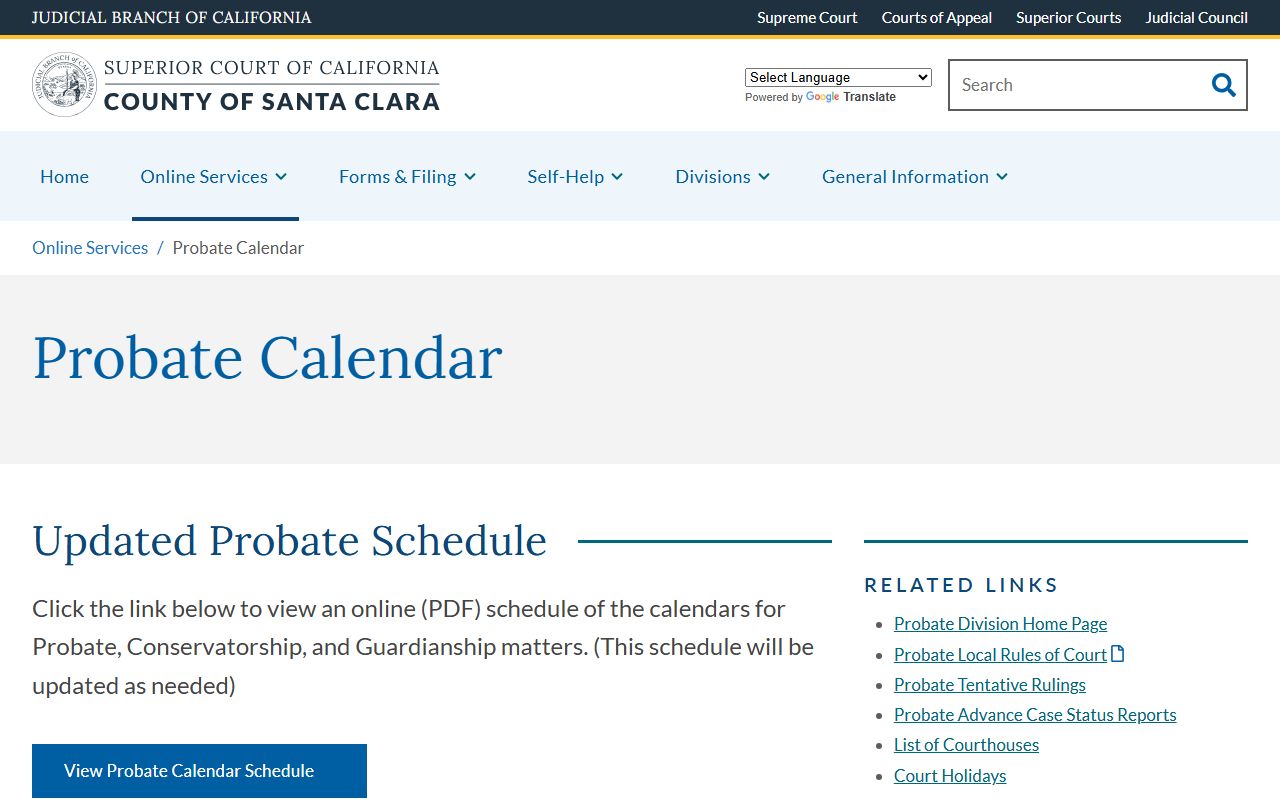
The image shows where the weekly probate PDF and scheduling rules sit on the court site.
Probate Fees and Costs
Probate is governed by the statewide civil fee schedule. The court links the current January 1, 2026 schedule on the forms and filing fees page. Filing fees are only part of the cost. Personal representative compensation, probate referee fees, and bond premiums add up across the case.
| Item | Amount |
|---|---|
| Filing fees | Set by statewide civil fee schedule |
| Statutory personal representative fee | 2% to 4% of the probate estate |
| Probate referee fee | 1/10 of 1% of appraised value |
| Probate referee minimum fee | $75 |
| Probate referee maximum fee | $10,000 |
| Total estimated cost | 4% to 7% of total estate value, sometimes more |
The total share rises when the estate sells real property, when bond is required, or when accounting and legal fees grow. The court self-help materials warn that probate can cost 4% to 7% of total estate value, sometimes more in complex cases.
Conservatorships and Guardianships
Conservatorship is the court process for adults who cannot care for their own person or finances. The probate examiners review the petition, the proposed conservator, and the investigator's report before each hearing. Conservatorship cases sit on the same probate calendar PDF as estate matters.
Guardianship is the process for minors. A non-parent steps in to care for a child's person, the child's estate, or both. The Probate Clerk's Office in Room 107 accepts guardianship filings and tracks investigator reports the same way as conservatorship matters.
LPS Mental Health conservatorships are run as a separate calendar. The court takes those filings by voicemail at 408-882-2651. The LPS line is used for filings and calendar questions only, not for general probate help. Confidential LPS files do not show up on the public portal.
Sample Probate Record Inventory
A probate record on the Case Information Portal returns a fixed set of fields. The image of any individual document is usually not online, but the docket text is. Knowing the field names helps a researcher pull what they need on the first search.
- Case number assigned by the Probate Clerk's Office.
- Decedent or estate name, or conservatorship/guardianship subject.
- Petition type (probate, conservatorship, guardianship, name change).
- Hearing date pulled from the probate calendar.
- Department where the hearing will be heard.
- Probate examiner notes posted in ACSR PDFs.
- Continuance and status notes added by the clerk.
- Documents filed via e-filing, listed in the docket but not generally downloadable.
To get a copy of a document, the requester places an order with the Probate Clerk's Office under the regular copy fees. Certified copies cost more than plain copies and are needed for banks and title companies.
Probate Glossary
Probate filings use a handful of legal terms that are not part of everyday speech. Knowing them makes both the petition and the order easier to read.
- Testator
- The person who made the will.
- Executor
- The person named in the will to carry out its terms.
- Intestate
- Dying without a valid will.
- Decedent
- The person who died.
- Personal Representative
- The executor or administrator appointed by the court.
- Letters Testamentary
- Court order giving the personal representative authority to act.
- Probate Referee
- State-appointed appraiser for non-cash estate assets.
- Conservatorship
- Court protection for an adult who cannot manage their own affairs.
- Guardianship
- Court protection for a minor's person or estate.
- ACSR
- Attorney Calendar Status Report listing examiner notes before each hearing.
Probate Self-Help and Attorney Referral
The Superior Court Self-Help Center helps with probate petitions, forms, and procedure. Staff can explain how to fill out a petition, how to give notice, and what to expect at the hearing. The Self-Help Center cannot give legal advice or represent a party, but it can keep a self-represented filer from missing a step.
The Santa Clara County Bar Association runs a lawyer referral service for probate work. The court's probate page links the SCCBA for filers who want paid counsel. Reach the Self-Help Center at 408-882-2926. Visit the probate court location page for the official referral menu the Probate Clerk's Office maintains.
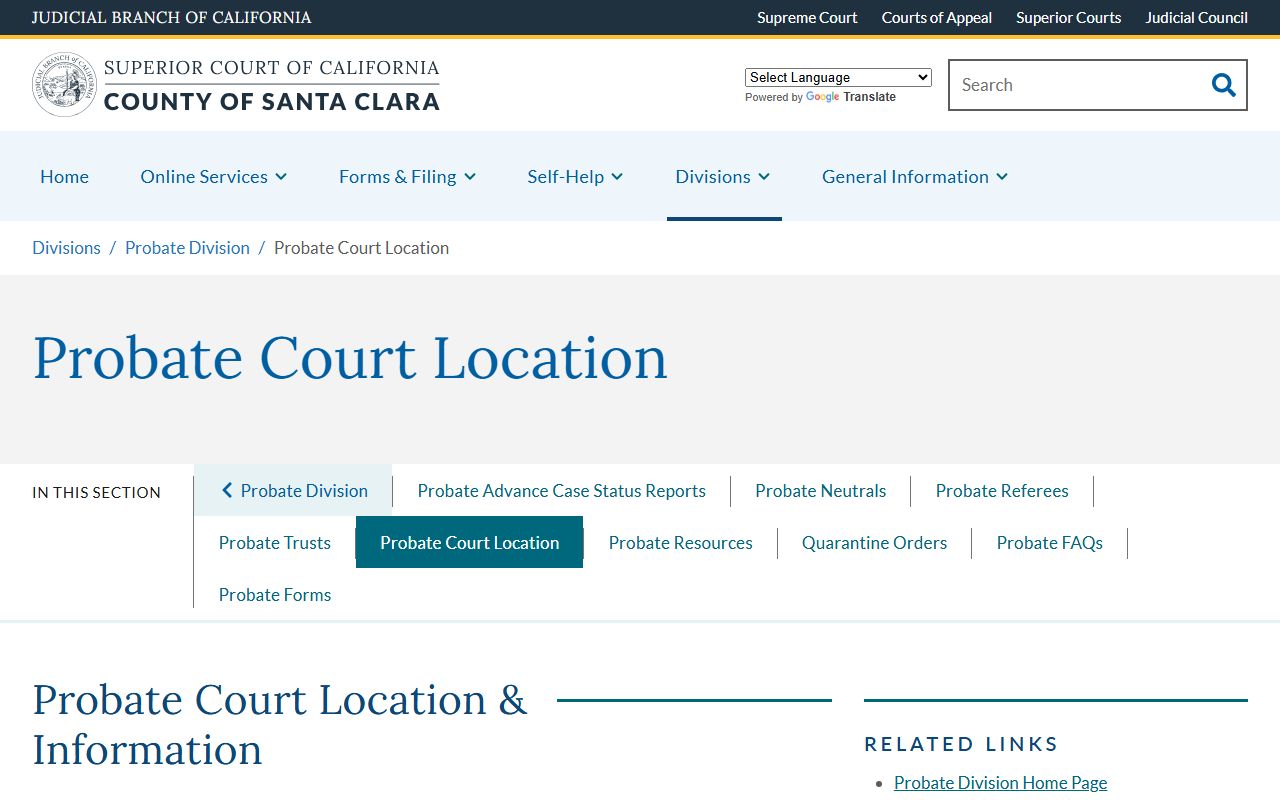
The page identifies Room 107 of the Downtown Superior Court and lists the same contact lines used by the clerk and the examiners.