
How to Search Santa Clara County Traffic Court Records
The court runs one main search tool: the Case Information Portal at portal.scscourt.org. The portal covers civil, small claims, probate, some family, criminal, and traffic and local-ordinance cases for the Superior Court of California, County of Santa Clara. Traffic searches pull case status, scheduled hearings, payment state, and warrant flags. Documents are not generally posted to the portal, but the case summary is enough for most ticket lookups.
Before a search, the driver should have the citation number from the ticket, or a full name plus a date of birth or driver license number. The citation number gives the fastest match. The portal is free to use and works around the clock. For in-person help, the Family Justice Center Courthouse at 201 North First Street in San Jose has a self-help center for traffic; the South County Morgan Hill Courthouse traffic counter is reached at 408-556-3000.
- Open the Case Information Portal and pick the traffic case lookup option.
- Enter the citation or case number from the top of the ticket, or pick the name search path.
- Add the driver last name, first name, and date of birth if no citation number is on hand.
- Submit the search and open the matching case for status, hearing, and payment details.
- Use the portal payment link, or call the Morgan Hill traffic counter for help on a delinquent case.
For background on the way the Superior Court runs its full case index, see the Santa Clara County court records page.
Which Courts Handle Traffic Cases in Santa Clara County
Santa Clara County does not run a stand-alone traffic court. Traffic calendars sit inside the Superior Court and split between two main courthouses. The Family Justice Center Courthouse in downtown San Jose handles the bulk of countywide traffic and self-help work. The South County Morgan Hill Courthouse covers the southern part of the county and also runs a criminal calendar. Misdemeanor traffic and DUI cases move to the Hall of Justice criminal calendar. A full court list lives on the court locations page.
Pick the courthouse based on where the ticket was issued. Most North County and central infractions go through the Family Justice Center. Southern citations route to Morgan Hill. A misdemeanor traffic charge, like driving on a suspended license, can land on the criminal calendar at the Hall of Justice on West Hedding Street.
Family Justice Center Courthouse
201 North First Street
San Jose, CA 95113
Traffic, self-help, and county-wide infractions
Portal: portal.scscourt.org
South County Morgan Hill Courthouse
301 Diana Avenue
Morgan Hill, CA 95037
Phone (traffic counter): 408-556-3000
Southern county traffic and criminal calendars
Hall of Justice
190 West Hedding Street
San Jose, CA 95110
Misdemeanor traffic and most DUI cases
See Santa Clara County criminal records
Note: A citation that lists a different courthouse on the back overrides the general split, since cases can be reassigned between locations.
Types of Traffic Cases on Record
The court files a wide range of traffic matters. Most are simple infractions, but the Vehicle Code also reaches misdemeanors, commercial driver issues, and photo-camera tickets. Juvenile traffic moves on a separate confidential track. The list below covers the main types tracked on the traffic side of the Case Information Portal.
- Infractions - speeding, stop-sign and signal violations, lane change, and most non-correctable moving citations.
- Correctable violations - "fix-it" tickets for expired tags, equipment, or license issues, cleared with a signed proof of correction.
- Misdemeanor traffic - driving without a license, driving on a suspended license, reckless driving, and hit-and-run with property damage under the Vehicle Code.
- DUI cases - charges filed under Vehicle Code 23152, routed to the criminal calendar.
- CDL cases - commercial driver license matters with stricter sanctions and federal reporting rules.
- Photo enforcement - red-light and railroad-crossing camera citations under Vehicle Code 21455.5.
- Local ordinance - parking and city or county code citations that travel through traffic calendars.
- Juvenile traffic - drivers under 18, handled with juvenile-confidentiality rules and routed in part through Juvenile Justice Court at 840 Guadalupe Parkway.
What Santa Clara County Traffic Court Records Show
The case summary returned by the portal is short but useful. Each field maps to a real step in the case, from the moment the ticket was written through the final disposition. The table below lays out the main fields and what each one means in a Santa Clara County traffic file. Documents like the citation image, court order, or proof of correction are not posted online; those are reviewed at the public access terminal in the courthouse.
A self-help page on the court site at santaclara.courts.ca.gov/self-help/self-help-topics walks new drivers through the parts of a traffic case file.
The image below shows the court's Self-Help Topics page, which includes traffic.
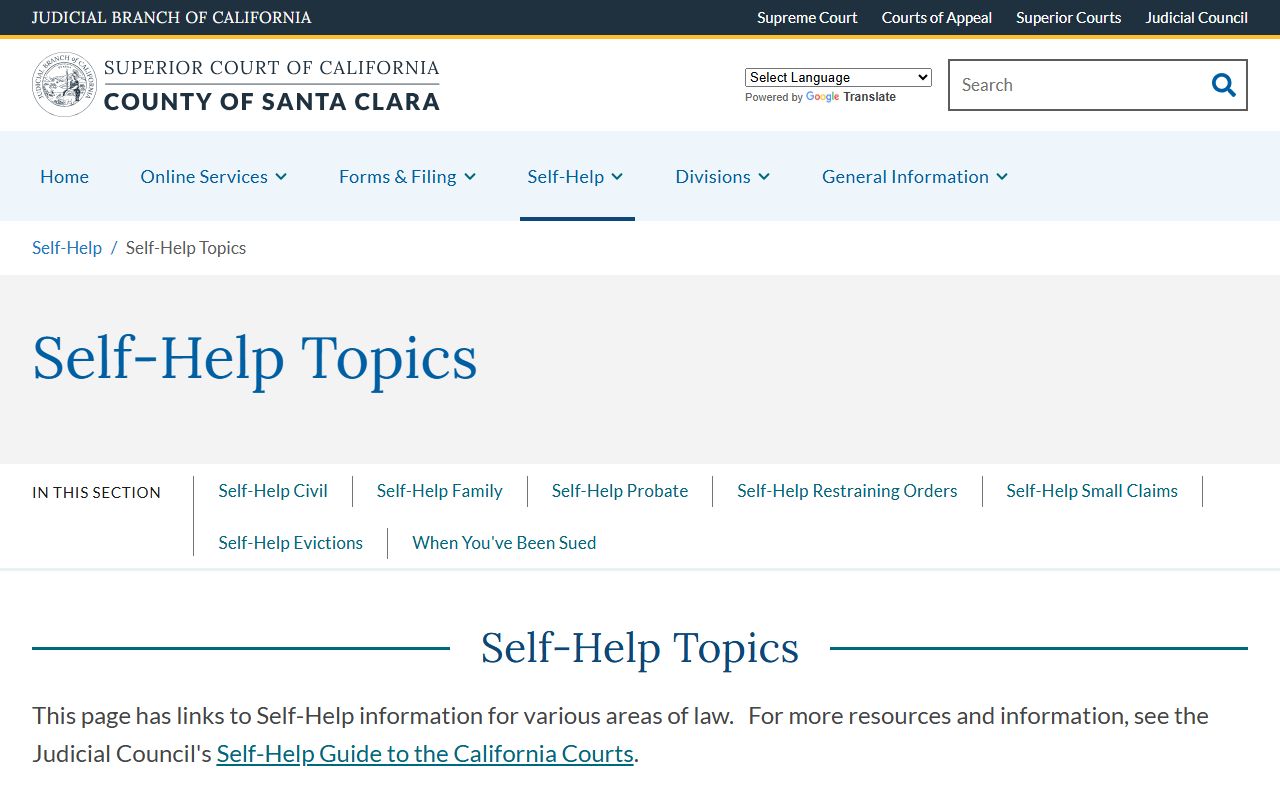
That self-help index is the court's main entry point for unrepresented drivers; the traffic links on it match the fields shown in the portal record summary.
| Field | What It Shows |
|---|---|
| Case Number | Internal court number; differs from the citation number after filing. |
| Citation Number | Number printed on the original ticket. |
| Charges | Vehicle Code or local ordinance sections cited. |
| Court Location | DTS, FJCC, Morgan Hill, or Palo Alto, based on the offense location. |
| Hearing Date | Arraignment or trial date, if set. |
| Status | Active, Delinquent, Warrant Issued, Paid, Complete, FTA, or Bail Forfeited. |
| Payment State | Due, Paid in Full, Partial, or On Hold. |
| Warrant | "Warrant issued on [date]" means a bench warrant is active. |
| Driving School | Eligible, Completed, or Not eligible for traffic violator school. |
| Disposition | Convicted, Dismissed, Bail Forfeited and Conviction Recorded, or Reduced. |
Searching by Citation Number vs by Name
A citation number is the fastest and most accurate way to find a Santa Clara County traffic case. The number is printed in the upper portion of the ticket and again on the back next to "Notice to Appear." When the ticket has been lost, the portal also takes a name plus a date of birth or driver license number. Type the name the way it shows on the license, since the portal does not do fuzzy matching.
Results come back with case status, payment state, hearing date, and a warrant indicator if one is active. The court warns that the online status is informational; a case recently transferred between courthouses or a payment recently mailed can show stale data for one or two business days.
| Field Label | Type | Required | Notes / Format |
|---|---|---|---|
| Citation / Case Number | text | preferred | Pre-printed on the back of the ticket; most reliable input. |
| Defendant Last Name | text | optional path | Pair with date of birth or driver license number. |
| Defendant First Name | text | optional path | Use with last name. |
| Date of Birth | date | optional path | Used with name when the citation number is missing. |
| Driver License Number | text | optional path | State license number where it applies. |
| Search | button | yes | Returns case summary, payment status, and warrant indicator. |
| Clear / Reset | button | optional | Verify in live portal. |
Paying or Contesting a Santa Clara County Traffic Ticket
A driver has several paths once the ticket is in hand. Pay it, request traffic violator school, ask for a trial by written declaration, or set the case for a court trial. The court mails a courtesy notice with the total amount due and the appearance date. That total includes the base bail plus statewide assessments and county penalty add-ons, so it is often higher than the figure on the ticket itself.
Missing the appearance date is the worst path. A delinquent case picks up a civil assessment of up to $100 under Penal Code 1214.1, and the court may issue a bench warrant. To clear an outstanding traffic warrant, the court points drivers to its warrants and corporate summons page. The Santa Clara County warrant records page covers the full warrant lookup process.
- Read the courtesy notice. It lists the total due, the appearance date, and the courthouse handling the case.
- Choose a path before the appearance date: pay in full, request traffic school, ask for trial by written declaration, or appear at arraignment and enter a plea.
- Pay online through the Case Information Portal payment link, by mail with a check to "Clerk of the Superior Court," or in person at the Family Justice Center or Morgan Hill courthouses.
- Request traffic violator school on or before the appearance date and pay the bail plus the state-set administrative fee.
- To contest by trial by written declaration, file a written statement under penalty of perjury along with the bail amount within the time stated on the notice.
- For a court trial, appear on the arraignment date, plead not guilty, and request a trial setting; the court schedules the trial within statutory time limits.
- If the appearance date passes with no action, the case becomes delinquent and the court issues the Penal Code 1214.1 civil assessment.
- A delinquent case with a warrant requires a court appearance or, where allowed, paying the bail plus the assessment to clear the matter.
Public Access Laws for Traffic Court Records
California opens most adult traffic case records to the public. The framework comes from the California Rules of Court 2.503 and rule 2.500, which govern public and remote electronic access to court records. Routine adult traffic case status is among the case types the Santa Clara portal exposes. Documents are usually not posted online, but a viewer can review them at the courthouse public access terminal.
The California Public Records Act, codified at Government Code section 7920.000 and following, controls agency records such as the DMV driver file. Court case files sit outside the CPRA in most respects but are still public under court rules. Juvenile traffic case files stay confidential under Welfare and Institutions Code 827, and sealed traffic orders follow the procedures in California Rules of Court 2.550 and 2.551.
Key statutes for traffic record access:
California Rules of Court 2.503 - sets remote electronic access standards for case records, including traffic.
Government Code section 7920.000 - California Public Records Act framework for state and county agency records, including DMV.
Welfare and Institutions Code section 827 - juvenile traffic records are confidential by default.
Court Traffic Records vs. State Driver Records
The court file and the DMV driver file are not the same record. The Santa Clara Superior Court holds the case file. The California Department of Motor Vehicles holds the driver record. A court conviction feeds the DMV record, but with a delay, and the two files serve different uses. The table below sets out the split.
| Item | Court Traffic Record | California DMV Driver Record |
|---|---|---|
| Maintained by | Superior Court of California, County of Santa Clara | California Department of Motor Vehicles |
| What it shows | One citation or case: charges, hearing, payment, disposition | License status, points, suspensions, abstracts of conviction from every California court |
| Where to access | portal.scscourt.org or in person at FJCC or South County | dmv.ca.gov driver record request |
| Time to update | Same day to several days after court action | DMV posts the abstract 30 to 60 days after court disposition |
| Use case | Verify a single Santa Clara ticket | Verify license status, point count, employer record check |
| To correct an error | File a motion in the court that took the action | Request a DMV correction with proof from the court |
| Public access | Case status visible online; documents not generally posted | Driver record is confidential; only the driver, authorized employers, courts, and law enforcement can request |
Note: A paid Santa Clara ticket can show closed in the court portal but still appear with a pending point on the DMV record while the abstract works its way through.
CDL and Commercial Driver Records
California issues commercial driver licenses under Vehicle Code section 15275 and the sections that follow, plus the federal rules in 49 CFR Part 383. A CDL holder must keep the license valid for the class of vehicle driven and for any hazardous-materials, passenger, or school-bus endorsement on file. Moving violations in any vehicle, personal or commercial, generally appear on the CDL holder's record.
Some serious violations trigger one-year disqualifications under 49 CFR 383.51. The court cannot mask a moving violation for a CDL holder through traffic school. The federal rule at 49 CFR 384.226 bars masking, even when the citation was written in a personal vehicle. The conviction still posts to the commercial record.
For an employer record check, the employer must request a copy of the driver record from the California DMV. The Santa Clara court file alone is not enough. A CDL holder who is suspended cannot drive a commercial vehicle during the suspension period, regardless of personal license status.
DUI / DWI Cases
California uses the term DUI. The misdemeanor charge sits at Vehicle Code 23152. DUI causing injury, at Vehicle Code 23153, is a wobbler, which means it can be charged as a misdemeanor or as a felony. Santa Clara does not handle DUI on the standard traffic calendar.
First-offense misdemeanor DUI is filed at the Hall of Justice in San Jose for most of the county. South County DUIs may go to Morgan Hill. A DUI case produces a criminal court record and a separate DMV administrative action against the license. The two run on parallel tracks, so a not-guilty result in court does not by itself restore the license. The image below shows the court's Collaborative Courts page, which lists DUI Court and other problem-solving tracks.
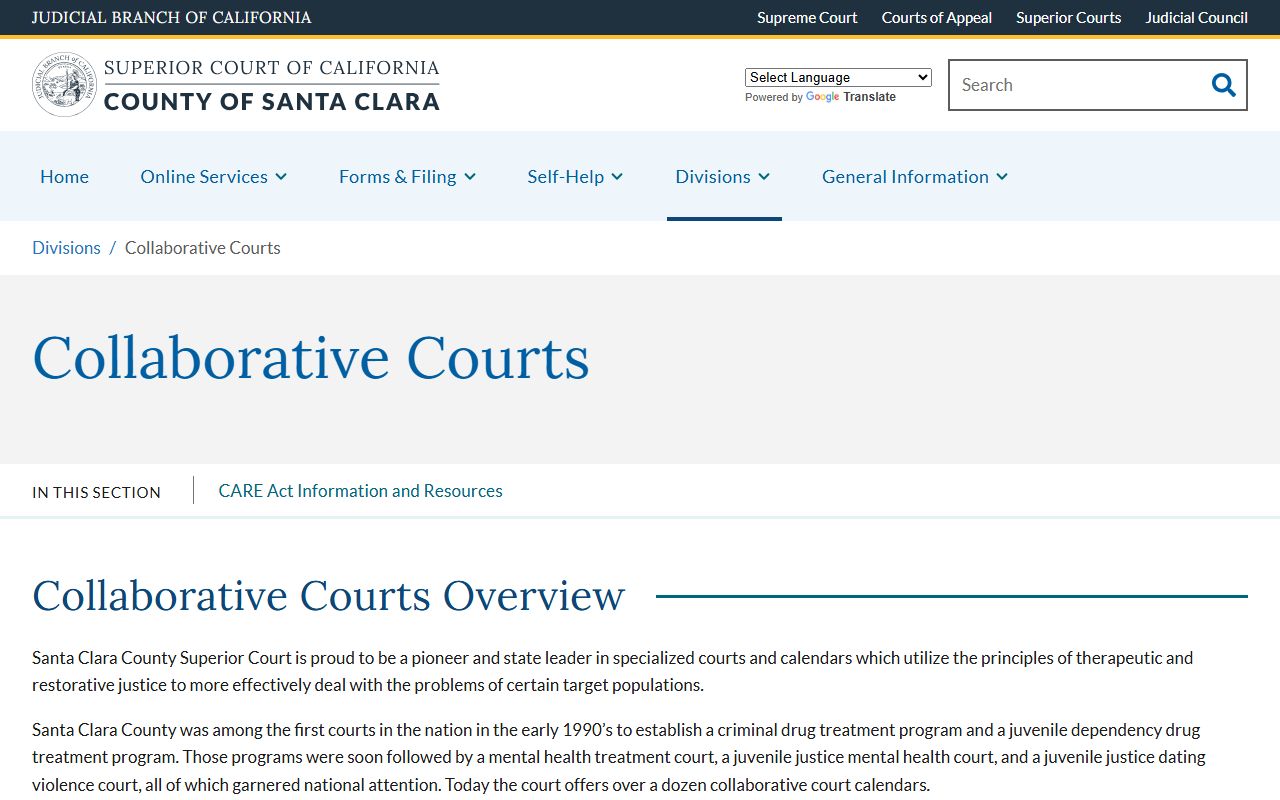
That Collaborative Courts page is where eligible repeat DUI defendants are routed; the standard calendar tracks misdemeanor DUI through the main criminal docket.
Felony or repeat DUI follows the criminal felony calendar and may involve probation, jail time, and required treatment. Full coverage of charging, sentencing, and record-clearing for DUI sits on the Santa Clara County criminal records page. The full case docket schedule is on the court dockets page.
Traffic Violator School (Deferred Adjudication Equivalent)
California's version of deferred adjudication for traffic is traffic violator school. Vehicle Code 41501 lets the court order TVS for eligible drivers. A completed certified course masks the conviction from the public DMV driver record for many infractions. The conviction still exists, but it does not post to the record that insurers and employers see.
Eligibility is one TVS dismissal in 18 months for a non-commercial driver. The driver must not hold a CDL and the citation must not include an alcohol-related charge. The court's traffic-school request adds a state-set administrative fee on top of the bail. The driver must finish a state-certified online or classroom course, and the school must report completion to the court before the deadline.
A CDL holder cannot use TVS to mask a moving violation under 49 CFR 384.226 and state law. Even a first offense in a personal vehicle counts against the CDL record. Drivers should check eligibility on the courtesy notice or call the Morgan Hill traffic counter at 408-556-3000 before paying the school fee.
Sealing or Expunging Traffic Records
Most paid or dismissed infractions do not need a separate sealing step. They drop off the public DMV driver record on a set schedule. A one-point violation rolls off after about 39 months. More serious offenses age off after seven to ten years, and a DUI stays on the DMV record for ten years from the violation date.
Misdemeanor traffic convictions can be dismissed under Penal Code section 1203.4 after probation is complete. The court order changes the conviction status in the court file but does not erase the DMV abstract. Penal Code section 851.91 sealing applies to arrests that did not result in conviction, which is less common for routine traffic stops but can apply when a misdemeanor traffic case is dismissed.
Juvenile traffic adjudications follow separate sealing rules under Welfare and Institutions Code section 781, and juvenile records are confidential by default under Welfare and Institutions Code 827. A clean court disposition does not by itself clear the DMV side. The driver waits out the statutory retention period or asks the DMV for a correction in writing.
Fees for Traffic Record Copies
The court charges the statewide schedule for copies, certifications, and clerk searches. The court's fees page links the full civil fee schedule, the traffic bail schedule, and the return-check fee. The table below covers the items most often charged in a traffic file.
| Item | Fee |
|---|---|
| Plain copy per page (Government Code 70627(a)) | $0.50 |
| Certified copy per document (Government Code 70626(a)(4)) | $40 |
| Search fee, no case number, beyond 10 minutes (Government Code 70627(c)) | $15 |
| Return check fee (Government Code 71386) | $50 |
| Civil assessment for missed appearance (Penal Code 1214.1) | up to $100 |
Total bail on a common infraction is not a single set number. Base bail plus statewide assessments and county penalty add-ons build the final amount, which the court prints on the courtesy notice. The court publishes its bail schedule on the same fees page linked above. For a certified copy of a traffic case file, contact the Clerk of the Superior Court. The clerk's office also handles fee waivers for low-income drivers.