
How to Find Recently Released Santa Clara County Inmates
The starting point is the Sheriff ATIMS inmate search. The same tool that lists current jail bookings also shows release status for past bookings still held in the system. A name search returns a row with a Custody Status column. Each row either reads "In Custody" or "Released MM/DD/YYYY." That single date is the release marker most users need.
No standalone official recent-release page was located on Sheriff or county navigation. The ATIMS app does contain hidden release-log and recent-bookings API methods inside its public JavaScript, which suggests an internal release feed exists, but the Sheriff has not exposed it as a separate public list. The practical path is to run a name search, or pull a booking by PFN or booking number, then read the status column. For older bookings dropped from the live roster, call the jail records line. Main Jail can be reached at 408-808-2800 or 408-299-3438.
A name search needs three fields at once: last name, first name, and birth date. PFN or booking number works alone. Without that combination the portal returns an error and no results. For people booked at Elmwood, the same roster covers both sites because the Sheriff runs custody countywide. See Santa Clara County inmate records for the full roster walkthrough.
How Release Status Appears in Santa Clara County Search Results
The ATIMS result grid shows eight columns. PIN holds the booking number. Name is shown last, first, middle. PFN is the inmate number. Birth Date is formatted M/D/YYYY. Race and Sex follow. Commit Date carries the booking time. The last column, Custody Status, is the one that matters for release tracking.
Click into a row and the system opens an Inmate Details page. If the person is no longer active, the detail view shows a "RELEASED" banner at the top of the card. Housing Location is hidden when the banner fires. The Admitted date stays in place, since the booking record itself is preserved. Total Bail Amount may read "NO BAIL," "Verify bail at the Main Jail lobby bail counter," "N/A," or a currency figure. None of those values reflect release.
Some fields stay private. Medical history, suicide watch flags, protective custody, classification details, juvenile bookings, confidential victim information, and full criminal history are not displayed. Certain case prefixes (52, 53, SJV) are filtered out of the public arrest list. The detail page is meant for public release verification, not for case-file review. For case-level data on a person released after a conviction, use the Santa Clara County court records portal or the criminal records page.
Setting Up Release Notifications with VINELink
VINELink is the public face of the VINE network. It tracks custody status across most county jails and state prisons and pushes free alerts when a person is released, transferred, or scheduled for a court date. For Santa Clara County, the VINE feed reads the same Sheriff custody data that powers the ATIMS roster, so a release recorded in the jail system normally triggers a VINE notice shortly after.
The Sheriff often hands out the VINE phone number and URL to crime victims at the booking stage. Anyone can sign up though. Family members, attorneys, landlords, and neighbors all use the tool. A registration needs an email or phone number and a search hit on the right person.
A look at the VINELink portal shows the live search and account screens used to register for alerts. 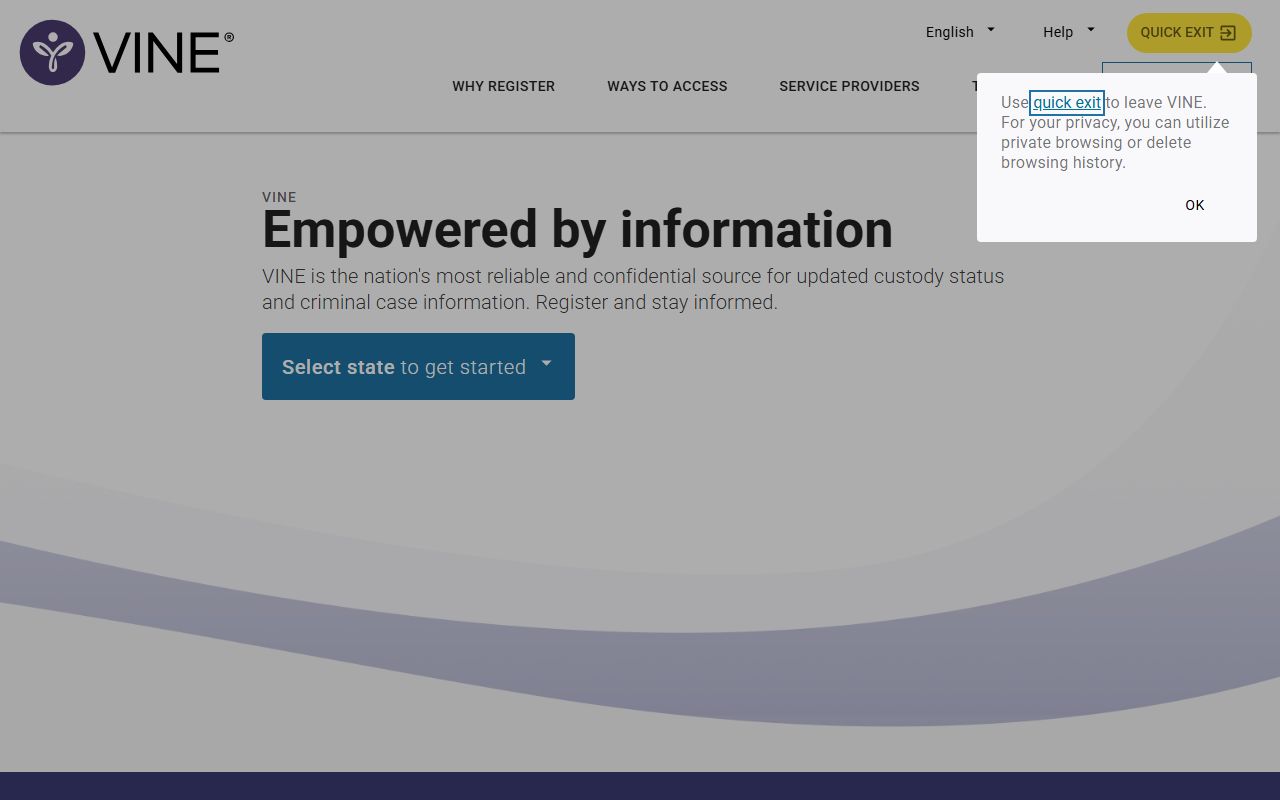 The same screen handles both the name search and the contact registration in one flow, which keeps setup short.
| Field Label | Type | Required | Options / Format Notes |
|---|---|---|---|
| State / location | dropdown/search | Yes | Select California or the relevant agency. |
| Name / ID | text | Yes | Search offender or defendant; exact labels require live browser verification. |
| Notification registration | web form | Conditional | User account or contact method required to receive alerts. |
The five steps below cover the full sign-up.
- Open vinelink.com in a browser.
- Select California, then pick Santa Clara County Sheriff as the agency, or leave statewide for prison releases.
- Enter the person's last and first name, or use a known ID number.
- Click the bell icon on the result and choose phone, email, or text alerts.
- Confirm the four-digit PIN VINE sends to the registered contact, then save the alert.
Note: VINELink alerts are not legal notice and should not replace a protective order or contact with the District Attorney victim services unit.
Searching State Prison Releases Through CDCR
People who were sent to state prison after a Santa Clara County conviction are tracked by the California Department of Corrections and Rehabilitation Inmate Locator. The locator covers every adult sentenced to CDCR custody and shows current location, parole status, and basic identifiers. A release from a state prison can be confirmed there, even after the person is back in the community on parole.
The locator runs two paths. Search by CDCR number gets the cleanest hit. Search by name needs a last name at minimum, with first name to narrow the list. The CDCR number is the most stable ID because names get misspelled at intake and may be entered in different formats over time.
| Field Label | Type | Required | Options / Format Notes |
|---|---|---|---|
| CDCR Number | text | Optional path | Exact state prison number; cleanest single-record hit. |
| Last Name | text | Optional path | Name search; pairs with first name to narrow. |
| First Name | text | Optional | Narrows result set. |
| Search | button | Yes | Runs the locator query. |
State release dates can shift. Good-time credit, milestone credit, and parole hearings all move the timeline. A locator hit from last month may not match this month's record. Re-run the search any time the date matters.
Searching Federal Releases with the BOP Locator
Federal cases out of the U.S. District Court for the Northern District of California land defendants in Bureau of Prisons custody. Federal release status is tracked at the BOP Inmate Locator. The tool covers people in BOP custody since 1982 and shows release dates for many who have already left.
The BOP Inmate Locator search page exposes the two main search tabs used by the public. 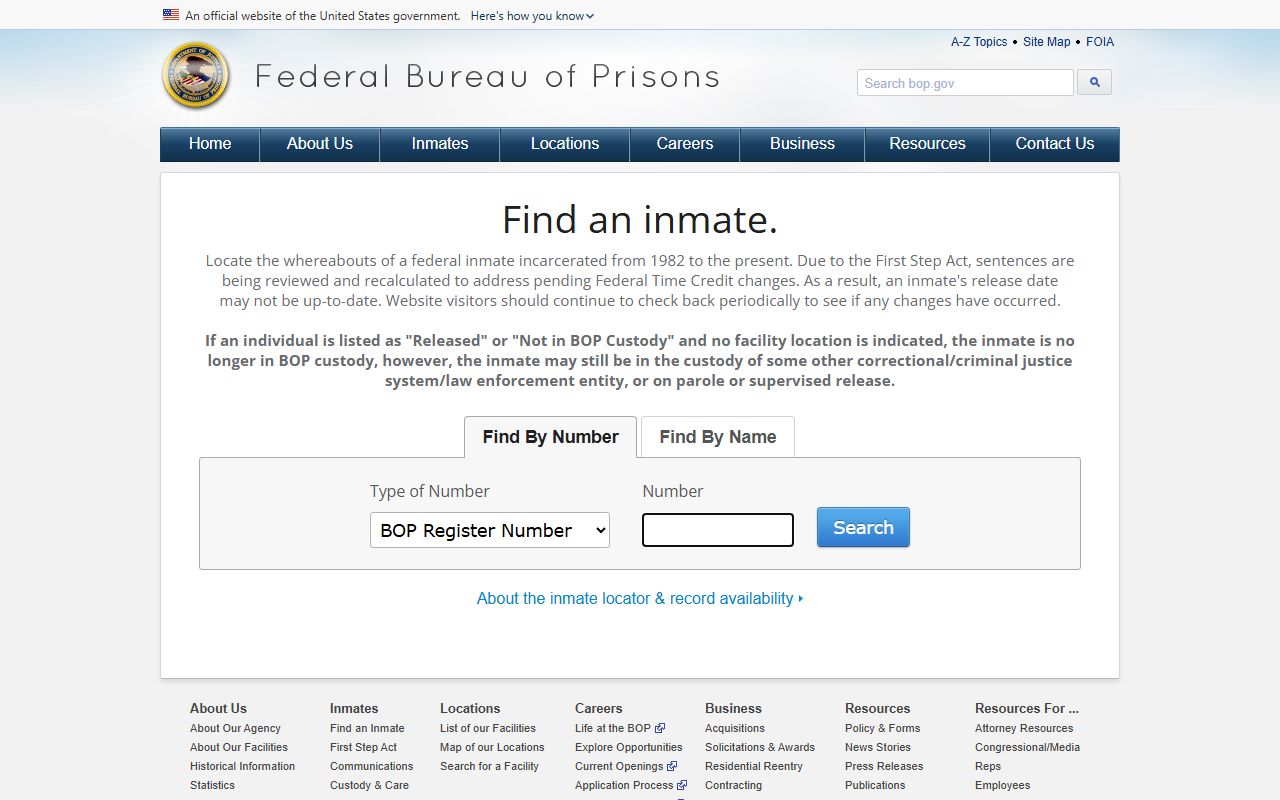 The Find By Number tab and the Find By Name tab live side by side and both produce the same result format.
| Field Label | Type | Required | Options / Format Notes |
|---|---|---|---|
| Find By Number | tab | Optional path | Search by BOP Register, DCDC, FBI, or INS number. |
| Type of Number | radio/dropdown | Yes for number search | BOP Register, DCDC, FBI, or INS. |
| Number | text | Yes for number search | BOP format shown as #####-###. |
| Find By Name | tab | Optional path | Search by name. |
| First | text | Required for name search | Required icon shown. |
| Middle | text | Optional | Optional. |
| Last | text | Required | Required icon shown. |
| Race | checkbox/filter | Optional | American Indian, Asian, Black, White. |
| Age | number | Optional | Age field. |
| Sex | checkbox/filter | Optional | Male or Female. |
| Search | button | Yes | Runs the locator search. |
| Clear Form | button | No | Clears all fields. |
A BOP result row returns a short set of fields per record.
- Name.
- Register number.
- Age.
- Race.
- Sex.
- Release date.
- Location.
If the row says "Released" or shows "Not in BOP Custody" with no location, the person is no longer held by the BOP. They may still be on federal supervision through U.S. Probation, or transferred to a different agency. First Step Act sentence-credit recalculations also shift listed release dates over time, so the date on a saved screenshot can fall out of date fast.
California Sex Offender Registry After Release
Many people released from state prison in California are required to register as sex offenders under Penal Code section 290. The public-facing registry is the California Megan's Law site, run by the Department of Justice. Public disclosure is governed by Penal Code section 290.46, which sets out what categories of registrants and what data can be shown to the public.
The text of Penal Code section 290.46 on the official legislature site lays out the public-disclosure rules. 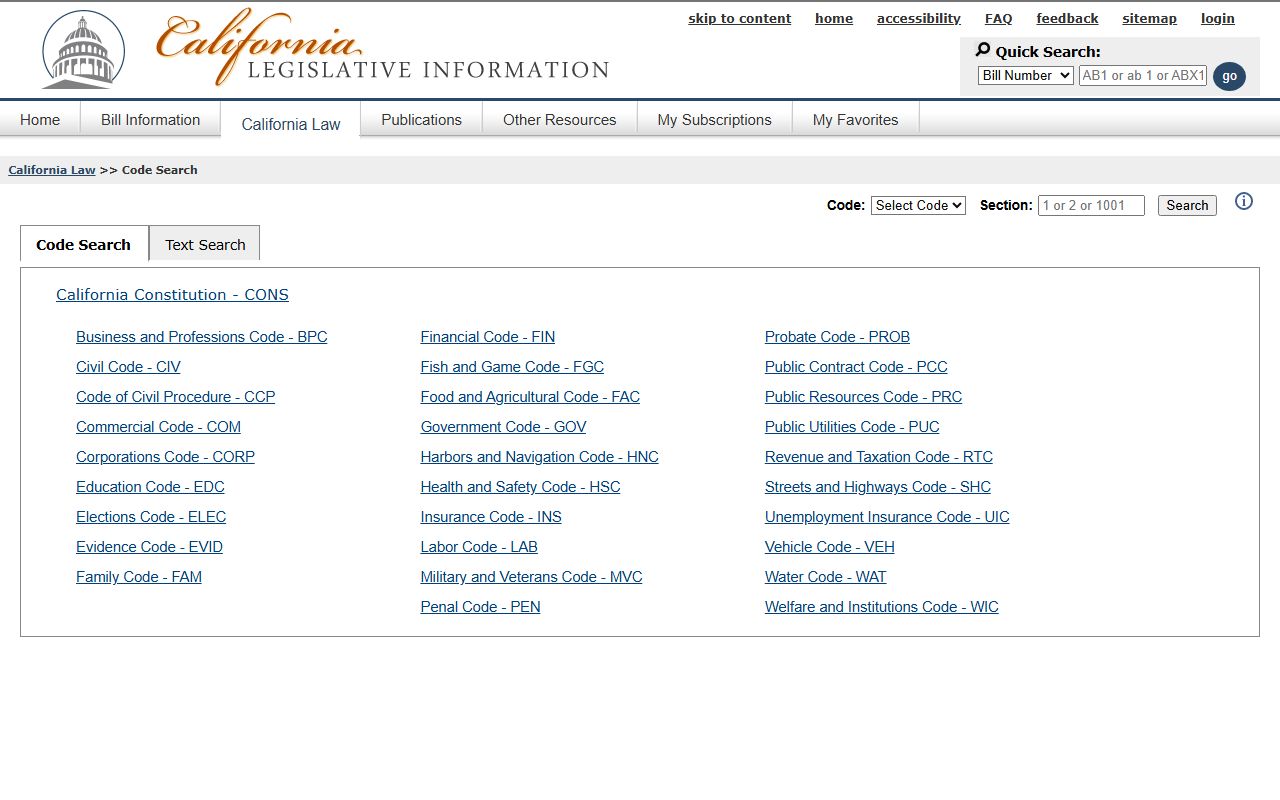 The statute defines which tier of registrant appears on the public site and which data fields the Department of Justice can publish.
| Field Label | Type | Required | Options / Format Notes |
|---|---|---|---|
| Disclaimer acknowledgement | checkbox/button | Yes | Must read and agree before any search. |
| Name search | text | Optional | Search by registrant name after continuing past the disclaimer. |
| Map / address search | text/map | Optional | Search by area; live labels vary. |
| City / ZIP | text/dropdown | Optional | Public search supports location filtering. |
The registry has clear limits. Only data allowed under California law is shown. Some registrants are not subject to public disclosure and never appear. Offenses other than the registration offense are not listed. Local law enforcement supplies much of the underlying data. Name, age, and address alone can misidentify a person, and misuse of registry data for harassment or a crime can lead to prosecution and civil liability. Use the tool as a starting point only.
Note: a missing record on the public Megan's Law site does not prove a person is not on the registry, since some tiers are kept off public view.
Which Database for Which Custody Type
Each tool covers a different slice of custody. The wrong tool will return a clean miss even when the person is on file somewhere else. The table below pairs the question with the right starting point.
| Custody Type | Primary Tool | URL | What It Confirms |
|---|---|---|---|
| County jail (Santa Clara) | Sheriff ATIMS Inmate Search | santaclara-inmatesearch.atimsle.com | Live custody status; "Released MM/DD/YYYY" on recent bookings. |
| State prison (California) | CDCR Inmate Locator | apps.cdcr.ca.gov/ciris | Current state custody and parole status for sentenced adults. |
| Federal custody | BOP Inmate Locator | bop.gov/inmateloc | BOP custody since 1982 plus listed release dates. |
| Notifications across types | VINELink | vinelink.com | Free alerts on release, transfer, and court dates. |
| Sex offender public registry | California Megan's Law | meganslaw.ca.gov | Public-disclosure tier registrants; subject to statutory limits. |
For people picked up on a federal hold but held at Santa Clara on a contract bed, both the Sheriff roster and the BOP locator may carry a record. Cross-check both before assuming someone has been released.
Verifying Release by Phone or In Person
The online tools are fast but not always current. Booking updates and release flags can lag the actual event by hours. When the timing matters, call the jail directly. The Sheriff's Office runs the custody system out of headquarters on West Younger Avenue and operates the two facility lines.
Santa Clara County Sheriff's Office
55 West Younger Avenue
San Jose, CA 95110
Main Jail 408-808-2800 / 408-299-3438
Elmwood Admin 408-957-5300 / Visitation 408-957-5900
Main Jail is at 150 West Hedding Street in San Jose. Elmwood Men's is at 945 Thompson Street, Milpitas. Elmwood Women's is at 701 South Abel Street, Milpitas. General Custody Bureau hours run Monday to Friday, 8:00 a.m. to 5:00 p.m. Release confirmation can be requested at the records counter or by phone.
For court-side verification of a sentence end date or a probation discharge, the case file at the Superior Court is the source of truth. See the Santa Clara County Superior Court page for the right division and clerk contacts. For an open booking that has not yet shown a release flag, check warrant status as well on the warrant records page; a person can be released from one booking but held on a fresh warrant.
Parolee Reentry Court and Reentry Resources
Santa Clara County runs reentry programs through two main channels. The Sheriff's Restorative Services Division is a custody-side program that connects in-custody and recently released people with vocational training, education, and community partners. Sheriff materials note that justice-involved students take part in vocational programs at Elmwood and at local community colleges.
The court-side channel is Parolee Reentry Court, one of the collaborative court calendars run by the Superior Court. The court's collaborative courts overview lists Parolee Reentry Court alongside drug treatment court, mental health treatment court, and Veterans Treatment Court. The reentry calendar borrows from drug-court and mental-health-court methods: team supervision, treatment compliance, and frequent court check-ins.
Common reentry needs after release include stable housing, drug or alcohol treatment, mental-health treatment, employment, and identification documents. The county's Social Services Agency, the Public Defender, and community-based legal aid groups all handle pieces of that work. People released to parole supervision should keep their assigned parole agent in the loop on address changes and program enrollment.
- Sheriff Restorative Services Division: vocational and education partnerships.
- Parolee Reentry Court: collaborative court calendar at the Superior Court.
- Public Defender: representation on record-clearing petitions.
- County Social Services: housing, food, and benefits intake.
Civil Rights and Voting After Release
California restores voting rights to people with felony convictions once they are no longer serving a term in state or federal prison. After release, a person on parole, probation, mandatory supervision, or post-release community supervision can register and vote. The Secretary of State publishes the current rule, and county elections offices handle the registration itself. Verify the live wording on the Secretary of State site before relying on it for a contested election deadline.
Other rights move on different timelines. Firearm rights are not automatic and require a separate restoration path under state and federal law. Some occupational licenses are reviewed by individual licensing boards on a case-by-case basis. Public housing eligibility depends on the housing authority and the underlying offense. Family law matters such as custody, visitation, and child support are decided in the Superior Court's family and civil divisions, not by parole agents.
A new arrest after release is not an automatic parole violation, but it can trigger a hold. People released to parole should keep documentation of completed programs and current employment, since those records help on both violation hearings and on later record-clearing petitions.
Record-Clearing After Release
California offers two main paths to clean up a criminal record after a Santa Clara County case ends. The first is dismissal under Penal Code section 1203.4, sometimes called expungement. A 1203.4 dismissal sets aside the conviction once probation has been completed in full, including fines, fees, and program requirements. The case stays on the rap sheet but is marked dismissed, which helps in most private hiring and many licensing reviews.
The second path is arrest sealing under Penal Code section 851.91. A 851.91 petition seals an arrest record when the case ended without a conviction, or when the statute of limitations has run and no charges were filed. A granted petition seals both the arrest and the related court file from most public view. Some criminal-justice users still see sealed records under narrow exceptions.
Filing happens in the trial court that handled the case. For most Santa Clara County matters that is the Superior Court at the Hall of Justice. The Superior Court page has the division and address details. People with low or no income can ask the Public Defender or court self-help center for help drafting the petition. A clean record after a 1203.4 or 851.91 order does not erase the underlying federal record, which is why a BOP search may still surface old data even after a state-level dismissal.
Note: record-clearing orders do not by themselves restore firearm rights or remove a sex-offender registration obligation.